Key Takeaways
- A full gas-to-induction conversion typically involves four separate jobs: the new range purchase, a dedicated 240V circuit, capping the abandoned gas line, and possibly a panel upgrade, which becomes necessary if your existing electrical service can't carry the added 40 to 50 amp load.
- Most induction ranges require a dedicated 240V circuit on a 40 or 50 amp breaker, the same class of circuit an electric coil range already uses, so homes converting from electric coil need less new wiring than homes converting from gas.
- Capping a gas line is plumbing work, not a DIY project in most California jurisdictions, since skipping the permit can create a disclosure problem at resale.
- SMUD has offered rebates on induction cooking, and California's income-qualified HEEHRA program offered point-of-sale discounts, but HEEHRA funding was reported fully reserved in early 2026, so confirm what is currently available before you budget against either.
- Induction cooktops require magnetic cookware. Cast iron and most stainless steel work, while aluminum and copper without a steel base plate do not, which makes this the most common surprise for first-time switchers.
What switching from gas to induction actually involves
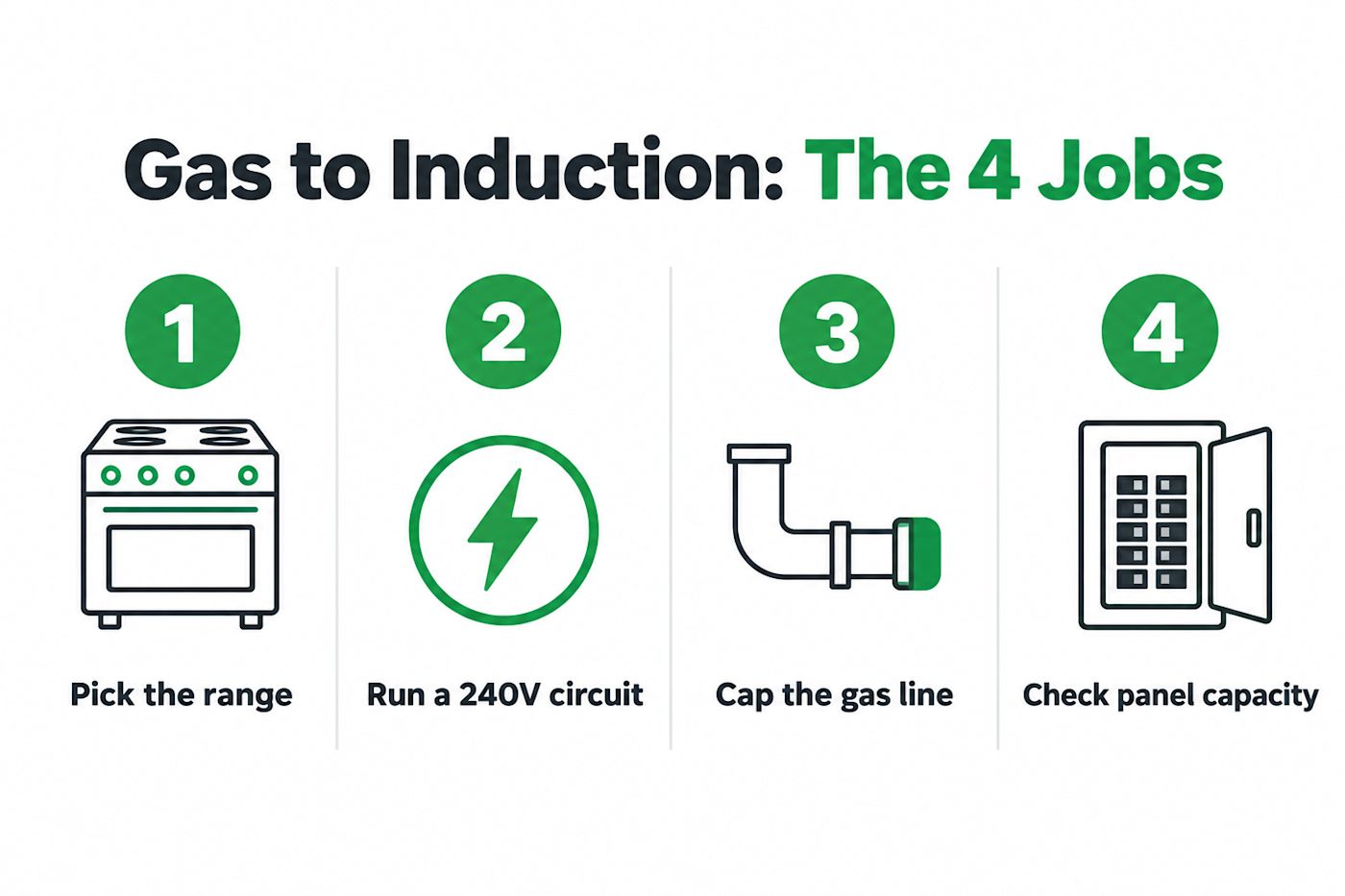
A gas-to-induction conversion is four distinct jobs stacked together, and skipping any one of them is what turns a weekend project into a stalled kitchen.
- Buying and sizing the range. Confirm the new unit fits your existing 30-inch (or other) cutout before you order it.
- Running a 240V circuit. Induction draws far more power than a gas range's spark igniter, so it needs its own dedicated line.
- Capping the old gas line. A licensed plumber seals the abandoned supply line behind the wall or floor.
- Panel capacity check. Your electrician confirms the panel has room for the new 40 to 50 amp circuit before pulling wire.
Whether the switch is worth it depends on what you value. Induction reaches a rolling boil faster than gas, because the cooktop heats the pan directly through induced current rather than heating air around it, and it also produces no combustion byproducts in the kitchen. The upfront electrical cost is the tradeoff against those benefits, and the sections below break down that cost in real numbers.
The 240-volt circuit an induction range needs
Yes, an induction range needs a 240V circuit, which places it in the same voltage class as an electric coil range or an electric dryer rather than the 120V a gas range's igniter runs on. Nearly every full-size induction range sold in the U.S. needs 240V; a few newer battery-assisted models plug into a standard 120V outlet, but they are the exception.
The circuit specification is consistent across major brands, calling for a dedicated 40 or 50 amp double-pole breaker sized to the nameplate rating stamped on the back of your specific range. GE Profile and Bosch 800 series units both fall in this range, though you should confirm the exact draw on the unit you buy. A NEMA 14-50 receptacle is the correct outlet for a plug-in range, since it is the same receptacle used for RV hookups and some EV chargers. If your kitchen already has one from a prior electric range, you may only need the electrician to confirm it's on its own dedicated circuit.
When your electrical panel needs an upgrade first
Your panel needs an upgrade first when a load calculation shows the existing service can't absorb the new circuit without exceeding its rated capacity, and an electrician determines this with a load calculation rather than a visual guess. A 100-amp panel that's already running central AC, an electric water heater, and an EV charger is the most common candidate for this problem, because each of those loads eats into the same 100-amp ceiling the new range circuit needs to share.
A 100-amp panel typically needs to move to 200 amps when the sum of your existing continuous and demand loads, calculated under NEC 220, leaves less headroom than the new circuit requires. If you're only adding the range and your panel is otherwise lightly loaded, the existing 100-amp service often still has room, since the electrician's load calculation decides the answer rather than the age of the panel alone. GVD Renovations handles the permitting process for jobs across the Sacramento Metro area and Northern California when a panel upgrade or new range circuit requires one.
Cost to run a new 240V line for the range
Running a new 240V circuit from the panel to the range location costs $450 to $1,500 in most homes, and more for long runs or added subpanels. The number moves with wire run length, whether the circuit runs through a finished wall or an open crawlspace, and whether the panel has an open breaker slot waiting or needs a subpanel added first, so a short run to a panel on the same wall as the kitchen costs less than a run across the house or up through a two-story structure.
Installing the 240V outlet itself, meaning the NEMA 14-50 receptacle, box, and cover plate, is a smaller piece of that total, and it is typically priced as part of the same circuit-run quote. Ask your electrician for the full scope and a firm total price before work starts, since the wire and receptacle cost is inseparable from the labor to route it.
How long the electrician's work takes
Each task in the conversion has its own timeline. It is the way these tasks stack back to back, rather than any single one, that determines how many days your kitchen is out of commission.
240V outlet or circuit install: a straightforward run with an open breaker slot typically takes an electrician 2-3 hours in a single visit.
- Full panel replacement: most residential panel upgrades are completed in one day. The power stays off only during the disconnect and reconnect window your utility schedules, because that is the only part of the job the utility itself controls.
- Utility coordination: SMUD's disconnect and reconnect process is what actually sets your outage window. It is usually measured in hours once scheduled, since the crew work before and after it happens independently of SMUD's timing.
- Gas line capping: a plumber typically completes this in under an hour once the range is disconnected, assuming clear access to the shutoff.
Capping the old gas line after the range comes out
The gas line gets capped in three steps. First, the plumber shuts off the supply at the meter or an upstream valve. Then the flex line is disconnected at the range's shutoff valve. Finally, a steel cap or plug is threaded onto the exposed pipe and pressure-tested to confirm no leak. Capping the line is plumbing and gas-fitting work, and the sequence matters, because capping before the shutoff is fully verified is a serious safety mistake.
Who is legally allowed to cap the line
Gas piping falls under the plumbing code, and capping a line is work for a licensed C-36 plumbing contractor rather than a DIY job. Changes to gas piping generally require a permit too, because gas work is life-safety work. That means an uninspected cap is exactly the kind of hidden defect a home inspector flags at resale.
Cost to cap a gas line and whether to keep it
Having a plumber cap a gas line costs between $150 and $450 total. It's usually billed as a flat visit fee, since the labor itself is brief. Whether to abandon the line in place (capped, inactive) or have it fully removed back to the meter is a judgment call. Keeping a capped line documented and permitted is acceptable to most buyers and inspectors, while an undocumented cap is a red flag. If you're selling within a few years, keep the permit paperwork with your other closing documents.
Total cost of switching from gas to induction in Sacramento
The table below breaks the conversion into its component costs so you can see where the money actually goes. Any utility or state rebates you qualify for generally apply to the range purchase, not the electrical or gas work. GVD Renovations provides a free, detailed fixed-price proposal before work starts, so this total becomes a firm number you approve.
| Task | Typical cost | Rebate-eligible |
|---|---|---|
| Induction range purchase | $1,200 to $8,000+ | Check current SMUD and state offers |
| New 240V circuit run | $450 to $1,500 | No |
| Panel upgrade (if needed) | Often $4,000 to $6,000+, varies with service size and utility work | No |
| Gas line capping | $150 to $450 | No |
The panel line is the one that swings the total most. If your existing service already has room, you skip it entirely, and the conversion is mostly the range price plus a single circuit run.
Will your SMUD bill go up after switching
Whether your SMUD bill rises depends on what you're comparing induction to. Against gas, your electric bill goes up by the cooking load, while your gas bill drops by about the same cooking portion, assuming you keep gas for other appliances.
Against an old electric coil range, induction typically uses less electricity for the same cooking task, since induction transfers roughly 85 to 90% of its energy into the pan, versus roughly 70 to 75% for a coil element that radiates heat into the air around the pan first.
What actually moves a SMUD bill is total household load more than the range itself, because air conditioning run time, an EV charging overnight, and rate tier all matter more month to month. An induction range's draw is intermittent and short-duration compared to HVAC.
Cookware and appliances that work on induction
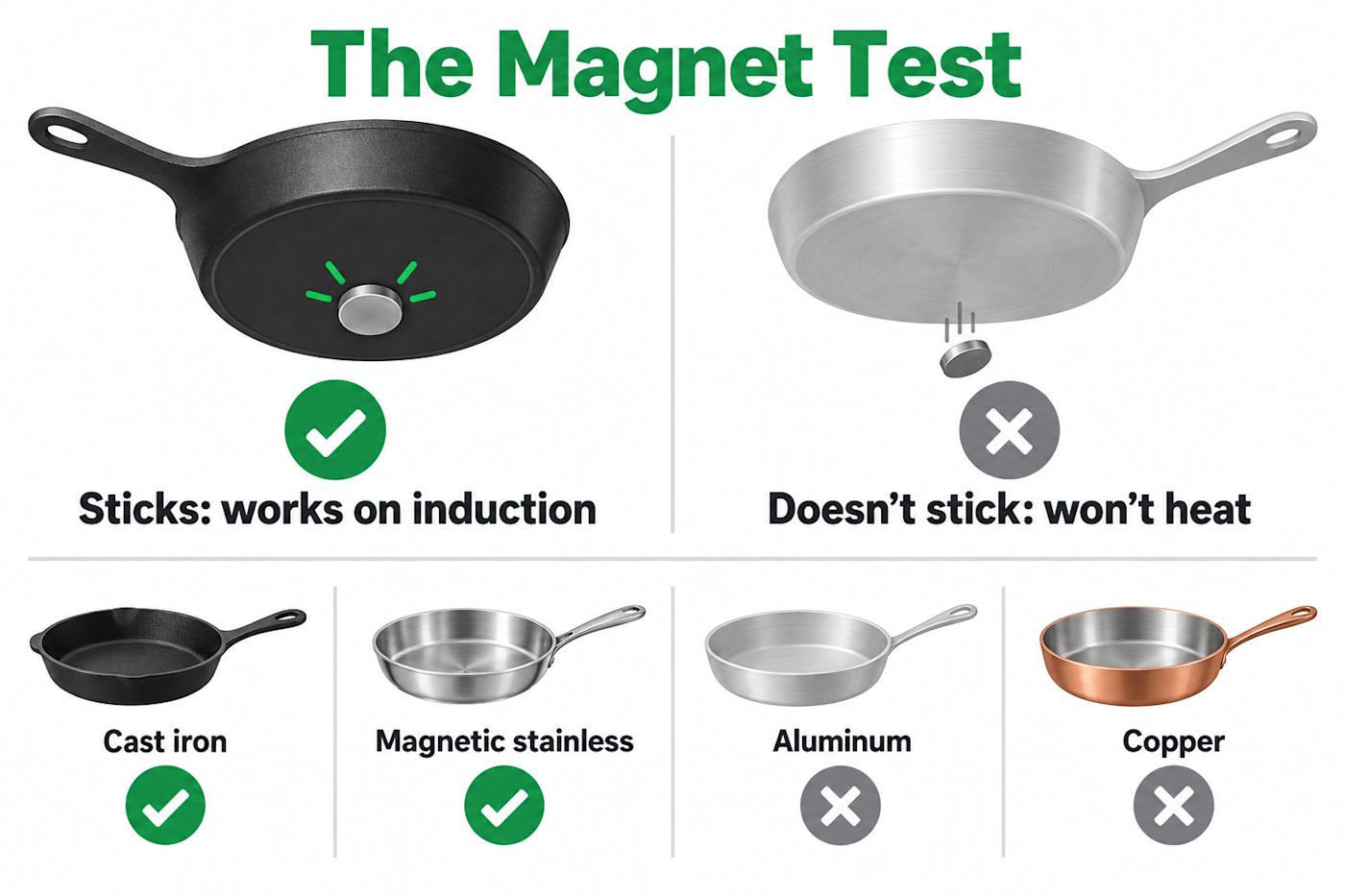
Induction cooktops heat only cookware with a magnetic base, because the surface works by inducing current directly in ferromagnetic metal instead of heating a coil or flame beneath the pan. A quick test: if a refrigerator magnet sticks firmly to the bottom of a pan, it works on induction.
Cast iron works on induction without modification, since it's fully ferromagnetic, and it's one of the few cookware types that performs identically across gas, electric coil, and induction. Most stainless steel works if it has a magnetic base plate, so check the manufacturer spec, since some all-clad-style stainless lines are induction-ready and some are not. Pure aluminum, copper, and glass cookware do not work unless they carry a bonded steel base. A full switch to induction sometimes means replacing two or three pieces of cookware rather than the entire set.
The real downsides of induction cooking
Induction has genuine drawbacks worth weighing honestly alongside its benefits.
- Cookware compatibility. As covered above, non-magnetic cookware simply won't heat. This forces a replacement cost some buyers don't budget for.
- Cooling fan noise. Induction cooktops run an internal cooling fan. Some users find it audible during high-power boiling. It's a complaint gas and coil ranges don't generate.
- Learning curve on heat control. Induction responds to dial changes almost instantly. Recipes calibrated to gas's slower ramp-up can overshoot. You need to adjust your habit to match.
- Power interruption risk. An induction range is fully dependent on grid power. A Sacramento outage takes your cooktop down entirely. A gas range with a manual-light burner might still function.
- Pacemaker concern. Induction cooktops generate an electromagnetic field. Manufacturers generally advise pacemaker or ICD wearers to consult their cardiologist before use. Modern medical device shielding has substantially reduced the real-world interference risk compared to older devices.
Induction vs gas vs electric coil for cooking
The comparison below covers the dimensions that actually decide a purchase: speed, control, safety, and the profile of who each option suits best.
| Dimension | Induction | Gas | Electric coil |
|---|---|---|---|
| Time to boil (typical) | Fastest, direct pan heating | Fast, visible flame control | Slowest, radiant coil lag |
| Cookware required | Magnetic base only | Any cookware | Any cookware |
| Combustion byproducts | None | Yes, NO2 and other combustion gases | None |
| Circuit needed | 240V, 40 to 50A | None (gas line) | 240V, 30 to 50A |
| Best for | Precise control, no gas hookup | High-heat wok cooking, visible flame feedback | Budget replacement, no rewiring |
Professional kitchens have historically favored gas for the immediate visual feedback a flame gives during high-heat searing and wok work. A growing number of commercial kitchens have adopted induction specifically for the speed and the elimination of ambient kitchen heat from open flame. For a home cook prioritizing boil speed and indoor air quality over flame feedback, induction is the stronger fit, while for a cook who values the tactile flame control gas offers during high-heat technique, gas remains the better match.
Booking the electrical and finish work for your conversion
Sequencing this job in the wrong order is the most common cause of delay. The range should be ordered first, to confirm cutout fit and circuit amperage from the nameplate. The electrician and plumber get scheduled second. Any cabinet or counter modification should land between the demo and the final electrical hookup, not after.
Coordinating an electrician, a plumber, and a kitchen contractor across one project is its own job, and it's the piece homeowners underestimate most. GVD Renovations assigns a dedicated project manager to jobs that touch the kitchen's cabinetry, counters, or layout, and that manager coordinates the work alongside the electrician and plumber on the project team, so the cutout, the circuit, and the capped gas line land on the same schedule. If your conversion is cabinetry-neutral, meaning the existing cutout fits the new range with no counter changes, you may only need the electrician and plumber directly. A licensed contractor in your area can confirm this during a walkthrough.
Next step: if your induction conversion involves any change to your kitchen's cutout, counters, or cabinetry, GVD Renovations offers a free in-home consultation to confirm fit and scope before you order the range, either at your home or at the Rocklin design showroom (6848 Five Star Blvd #6).
Reviewed by our team at GVD Renovations, a licensed general contractor. While we strive for accuracy, project specifics vary — contact us for a personalized assessment. Product details, specifications, or warranties may have changed since publication. Brand and product mentions reflect our professional opinion, not endorsements or guarantees.
Tags: gas to induction, induction range, kitchen remodeling, electrical panel upgrade, sacramento,
Written by Paul Kho