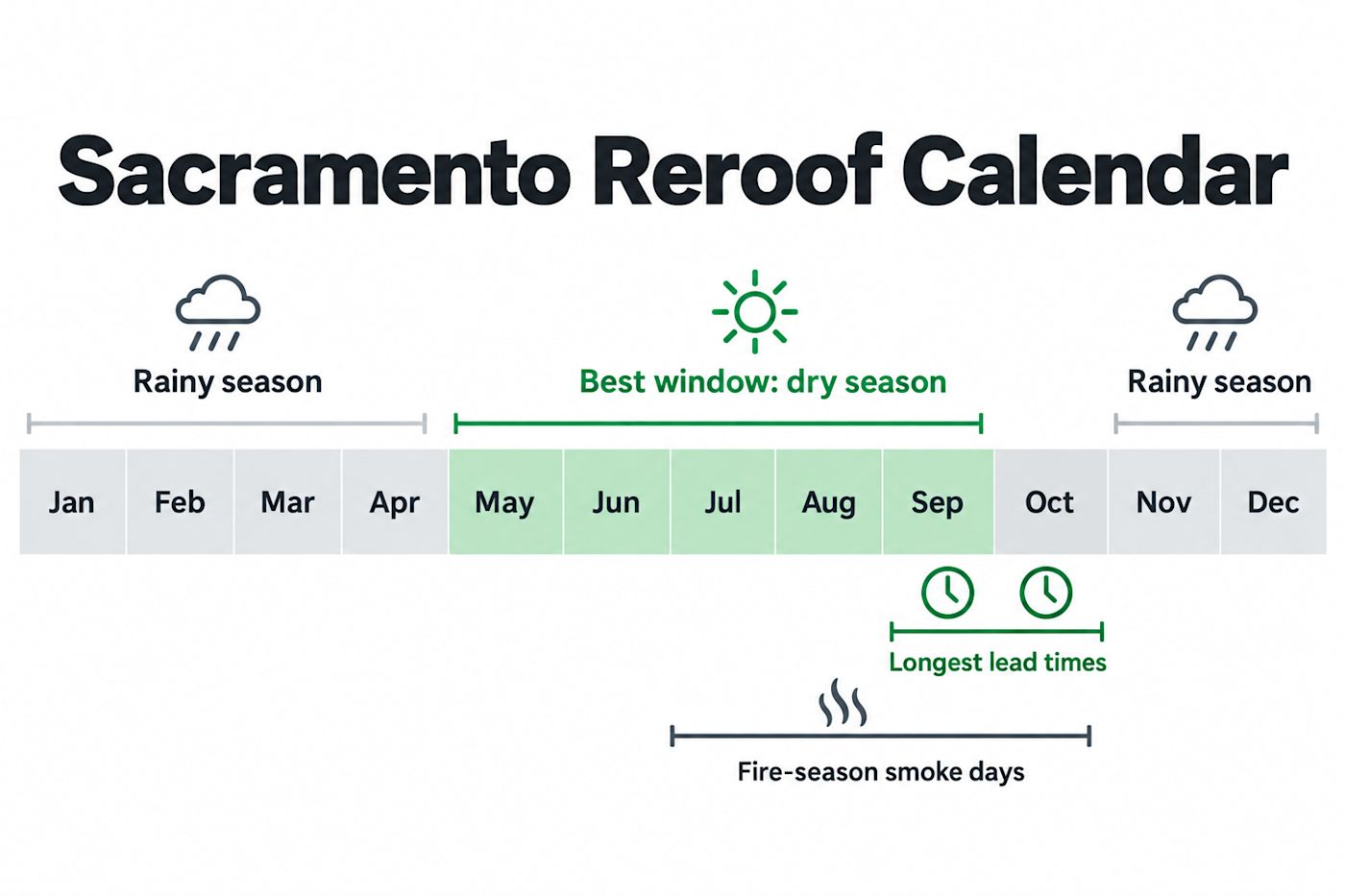
If you reroof a Sacramento house between May and September, your crew works dry weather from tear-off to final inspection, with no tarps, no rain delays, and no risk of an open deck catching an early storm. That window is the answer.
Key Takeaways
- The dry-season window for a Sacramento reroof runs roughly May through September, with June and early July offering the shortest crew lead times.
- Sacramento's rainy season typically starts in mid to late October, and an open deck caught by rain can mean soaked sheathing and a stalled job.
- Booking lead times stretch in September and October as homeowners race the first storm forecast, leaving far less scheduling flexibility.
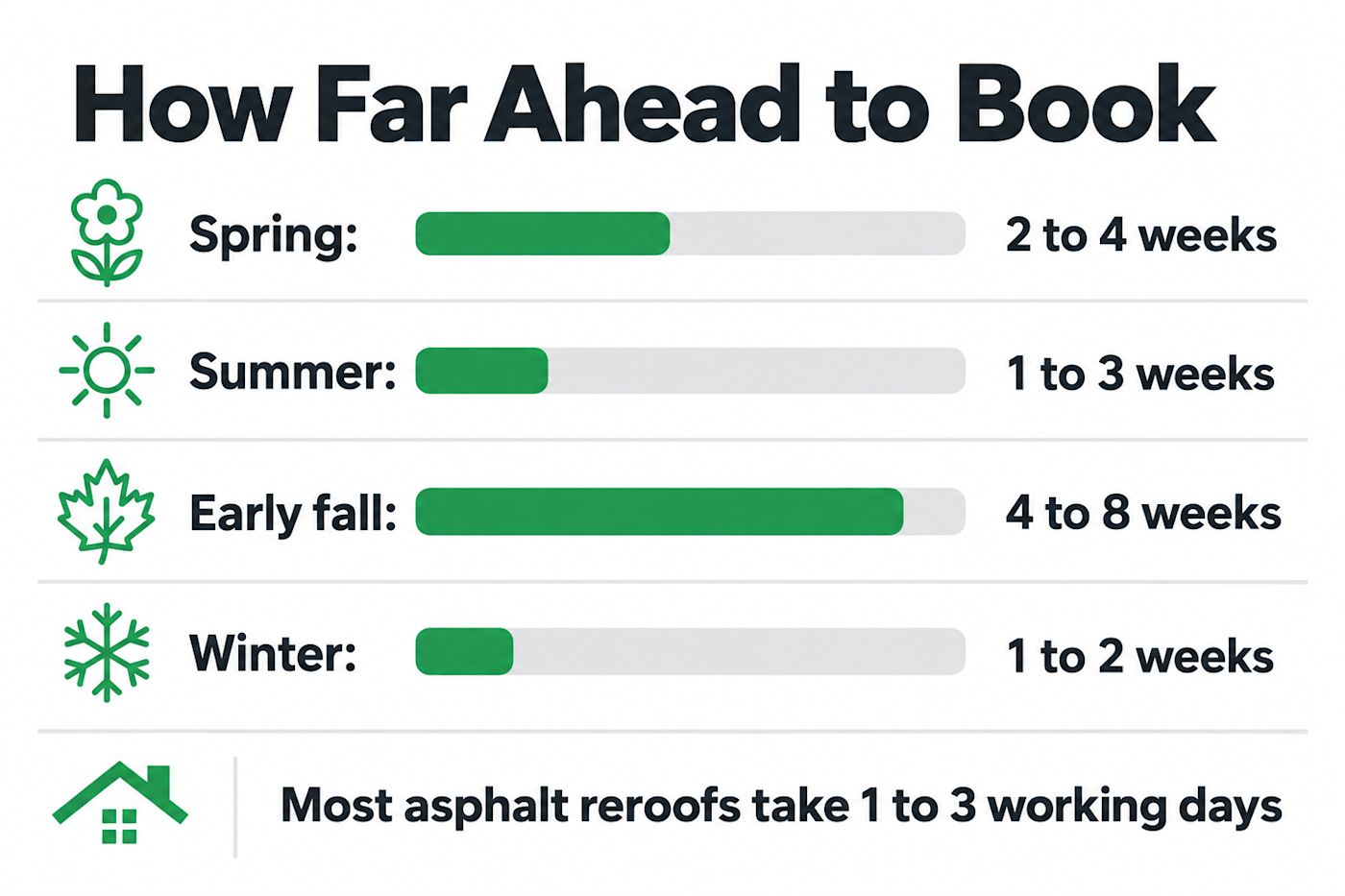
- Most asphalt shingle reroofs take one to three working days in dry weather; tile takes longer.
- Peak regional fire season runs roughly July through October, and smoke-advisory days can pause outdoor work even when the roof deck itself is unaffected.
- Sacramento-area reroofs generally require a permit through the City of Sacramento or Sacramento County, though requirements vary by scope and jurisdiction.
When is the best time to replace a roof in Sacramento?
The best window for a Sacramento reroof is late spring through early fall, roughly May to September, when the valley stays dry enough for crews to tear off old material and dry-in a new roof the same day. A reroof with an open deck is vulnerable to any rain that falls before the underlayment and new shingles or tile are secured, so a predictable dry stretch matters more than any other scheduling factor.
That window beats the alternatives because it removes the two variables that cause the most delay: rain and crew backlog. Winter brings real storm risk and frequent weather delays. Fall carries the longest lead time of the dry-adjacent seasons because homeowners who wait for the first rain forecast all call contractors at once, and crews that are already booked cannot compress a two-day tear-off into one.
Signs your roof needs replacing before the next Sacramento winter
Full replacement is the right call when the damage affects the roof's ability to shed water through an entire rainy season. The signs below indicate a patch buys only a few weeks of protection before the problem resurfaces.
- Granule loss and bald spots: if gutters are collecting more than a handful of granules after a normal rain, the asphalt underneath is exposed to UV and will crack faster through the dry heat that follows.
- Curling or clawing shingles: shingles that lift at the center or curl at the edges have lost their seal and will blow off in the first strong wind event of the season.
- Soft decking or sagging rooflines: this usually means trapped moisture has already rotted the boards underneath, and a patch does nothing for the structure below the surface.
- Daylight visible in the attic: gaps big enough to let light through are big enough to let rain through once storms arrive.
- Multiple roofs on your street replaced in the same year: subdivisions built in the same construction wave tend to age out together, since the roofing material installed at the same time degrades on a similar timeline.
California does not set a fixed replacement interval; it depends on the material. Asphalt shingle roofs in the Sacramento Valley's heat and UV exposure run toward the shorter end of their 20 to 30 year rating, while concrete and clay tile commonly reach 50 years or more. Repair is enough when the damage is localized (a few cracked shingles, one missing flashing strip) and the rest of the roof tests sound; replacement is the right call when the damage is spread across multiple roof planes or the underlying decking is already compromised.
Spring vs fall vs summer roof replacement in Sacramento compared
Spring, summer, and fall each trade rain risk, heat, and booking lead time differently, so the right choice depends on which constraint affects you most.
| Season | Rain risk | Typical high temp (deg F) | Crew lead time (weeks) | Pricing pressure |
|---|---|---|---|---|
| Spring (Mar to May) | Moderate, early spring storms possible | 65 to 80 | 2 to 4 | Standard |
| Summer (Jun to Aug) | Low | 90 to 100+ | 1 to 3 | Standard |
| Early fall (Sep to mid-Oct) | Low, rising through October | 78 to 90 | 4 to 8 | Highest demand, least flexibility |
| Winter (Nov to Feb) | High | 54 to 62 | 1 to 2 | Lower demand, but tarping and weather days offset savings |
Summer carries the shortest lead time because fewer homeowners are racing a storm deadline and crews can plan tear-off days with confidence. Fall carries the highest rain risk of the three, not because October itself is especially wet, but because a late-month storm can arrive before a delayed project finishes, and the backlog from procrastinating homeowners means less flexibility to reschedule around it.
Can roofers work during Sacramento's rainy season?
Sacramento roofers do install roofs through the rainy season. They time jobs to the dry windows between storms. They tarp the open deck whenever rain is forecast mid-job. A winter reroof is workable; it is just less predictable than a May start date.
Roofers do install in winter when a forecast shows a multi-day dry stretch. They build in contingency days that a summer schedule does not need. When rain interrupts a job already underway, the standard practice is to secure a weather-rated tarp over any exposed decking before the crew leaves for the day. This protects the sheathing. It also adds a day back to the schedule once the tarp needs to come off and work resumes. Winter installation in Sacramento is acceptable as long as the contractor is tracking the forecast closely and has tarping materials on site. A winter emergency justifies a winter reroof. Homeowners who have a choice should still aim for the dry season instead.
Crew lead times and why pricing climbs toward the rainy season
Booking lead times in Sacramento stretch as the September-October pre-rain rush builds. Homeowners who wait until the first rain forecast compete for a shrinking pool of open crew slots. Book 4 to 8 weeks ahead if you're aiming for a fall completion. Book even earlier if you want a specific contractor's team; those slots fill before the general pool does.
September and October get backed up because every homeowner who put off a spring or summer decision now wants the job finished before the first storm. This compresses months of normal demand into a narrow window. Winter demand for outdoor remodeling work is lower, but winter reroofing is not the cheapest option. Added tarping, scheduling contingencies, and shorter daylight hours tend to offset whatever discount a slow season might otherwise produce.
Do you need a permit to replace a roof in Sacramento, and how long the job takes
Sacramento-area reroofs generally require a permit through the City of Sacramento or Sacramento County. The exact requirement depends on the scope of work and the jurisdiction your property falls under. A licensed contractor handles the permitting process when one is required. This spares you a separate trip to the counter.
A full tear-off and reinstall of an asphalt shingle roof on a typical Sacramento home usually takes one to three working days in dry weather. Tile roofs often take longer, because of the added weight and the care needed when removing and resetting existing tile. You do not need to stay home during the work itself. The crew will want someone reachable by phone for any decisions that come up, such as unexpected decking damage found during tear-off.
Replacing a roof in Sacramento summer heat: shingles vs tile
Sacramento summers routinely hit 100 degrees or more, which speeds the thermal seal on new asphalt shingles but also raises the risk of scuffing the surface and fatiguing the crew during midday hours. Extreme heat does not close the workable window; it shifts crews toward early starts and shorter afternoon shifts.
Heat does not change which months are workable for tile, since concrete and clay tile are installed cold and do not rely on thermal sealing the way shingles do. For shingles, the practical effect is limited to a schedule adjustment: crews still work during summer, but start at or before 7 a.m. and often wrap up before the 2 p.m. peak to protect both the material and the installers.
Asphalt shingles: faster sealing but scuff risk above 100 degrees
Heat helps asphalt shingle installation by activating the self-sealing strip on the underside of each shingle faster than cooler weather would, which locks the roof down against wind sooner. The tradeoff is that soft, heat-softened shingles scuff and scratch more easily underfoot above roughly 100 degrees, so a conscientious crew limits foot traffic on finished sections and schedules the physically demanding tear-off work for the cooler morning hours.
Concrete and clay tile: heat-neutral during install
Tile installation does not depend on temperature-activated adhesives or sealing strips, so summer heat changes nothing about when tile can go down. The limiting factor for tile is crew endurance and hydration breaks rather than any material behavior, which means a tile reroof can proceed on a 105-degree day with the same result as a 75-degree one.
How to schedule a roof inspection and get quotes before buying or reroofing
Line up an inspection and comparable quotes in this order if you're planning a reroof before the rains arrive, or evaluating a roof before closing on a house:
- Call for an inspection as soon as you notice a sign of damage, or as a standard part of a home purchase contingency; most inspections take 30 to 60 minutes for a single-family roof.
- Ask the inspector for photos of any problem areas in addition to a verbal summary, so you can compare findings across multiple contractors.
- Request quotes from at least two or three contractors, each covering the same scope of work (full tear-off versus overlay, same material grade) so the numbers are directly comparable.
- Confirm each quote includes a firm total price. A contractor who won't commit to a firm number up front is harder to hold to the final bill.
- Book your preferred contractor at least a month ahead of your target start date if you want a summer or early fall slot, since that is when crew calendars fill fastest.
A roofer who avoids a clearly documented scope, pressures same-day signing, or can't explain why their price differs sharply from competing quotes is worth a second look before you sign anything.
What decides the right month: rain, heat, fire season, and crew lead times
Four factors set the right month for a Sacramento reroof, and they rank in this order of how much they move the decision: rain risk first, crew lead time second, fire season third, heat last. Rain risk matters most because an unfinished tear-off caught by a storm risks the decking itself, a cost no other factor comes close to.
Crew lead time ranks second because it determines whether you can even get on a schedule before the rains start, regardless of which month you'd prefer. Fire season ranks third: it rarely stops a job outright but can add smoke-advisory delays during the worst weeks of July through October. Heat ranks last because it changes the working rhythm of the day without closing off any month on the calendar. In practice, the four factors trade off together: booking early in spring avoids the fall lead-time crunch, which avoids the rain-risk deadline, which keeps the heat and smoke considerations easy to manage.
Fire season and wildfire smoke: how they affect roofing timing and material choice
Peak fire season in the Sacramento region runs roughly July through October, overlapping directly with the second half of the dry-season reroofing window, and can bring smoke-advisory days that slow or pause outdoor work.
Wildfire smoke does stop crews from working on the worst air-quality days, since prolonged outdoor labor in hazardous smoke conditions is a safety issue independent of the roofing work itself; a job might lose a day or two during a bad smoke event rather than the whole window. Fire exposure does change material choice for homeowners in wildland-urban interface areas near the foothills. Concrete tile, clay tile, and most fiberglass asphalt shingles can achieve a Class A fire rating, but that rating applies to the tested roof assembly (underlayment and deck included), so contractors in foothill-adjacent zones pay close attention to the full assembly, ember-resistant vents, and edge details, not just the roofing product.
Sacramento's rainy season and why the first storm is the real deadline
Sacramento's rainy season runs roughly October through April, with the first significant storms usually landing in mid to late October, which makes finishing before that first storm the hard constraint on any reroof scheduled for late summer or early fall.
Finishing before the first rain matters because a partially completed roof, one with the old material removed but the new underlayment or shingles not yet installed, has no protection against water at all. If rain hits mid-tear-off, the crew tarps the exposed decking, but a soaked substrate underneath a tarp can still develop mold or warping if the tarp is compromised by wind, which is why contractors push hard to complete tear-off and dry-in within a single working day whenever a forecast shows rain approaching.
Frequently asked questions about replacing a roof in Sacramento
How often should a roof be replaced?
Replacement frequency depends on material: asphalt shingle roofs typically need replacement every 20 to 30 years, while concrete and clay tile commonly last 50 years or more. Sacramento's summer heat and UV exposure tend to push asphalt toward the shorter end of that range.
What does a roof replacement cost in Sacramento?
Costs vary with material, roof pitch, and whether the job is a tear-off or an overlay. On GVD projects, a typical asphalt shingle replacement runs about $18,000 to $28,000, and tile or metal costs more. See our Sacramento roofing page for current ranges; a fixed-price proposal after an inspection is the only reliable number for your house.
What time of year is cheapest to replace a roof?
Winter is sometimes assumed to be cheapest because demand for outdoor remodeling slows, but the added tarping contingencies and scheduling unpredictability in Sacramento's rainy season tend to offset that advantage. Early spring booking often captures summer labor rates before the fall rush pushes demand up.
Should I stay home during roof replacement?
You do not need to stay home for the full job, but it helps to be reachable by phone in case the crew finds unexpected decking damage or needs a decision on material substitutions mid-project.
Can a roof be replaced before an El Nino winter?
Yes, and an El Nino forecast is a reason to book earlier rather than later: El Nino winters tend to bring heavier and more frequent Sacramento Valley storms, which shrinks the margin for a delayed fall start and raises the cost of guessing wrong on timing.
Lock in a Sacramento reroof before the rains: your next step
If your roof shows any of the signs above, get an inspection now rather than waiting for the first fall storm to force the decision. GVD Renovations, a licensed Sacramento-area roofing and remodeling contractor (CSLB #989637), offers free in-home consultations and a detailed fixed-price proposal before any work starts, which gives you a firm number to compare against other contractors while you still have the dry season ahead of you.
Reviewed by our team at GVD Renovations, a licensed general contractor. While we strive for accuracy, project specifics vary — contact us for a personalized assessment. Product details, specifications, or warranties may have changed since publication. Brand and product mentions reflect our professional opinion, not endorsements or guarantees.
Tags: roof replacement, best time to replace roof, reroof, roofing, sacramento,
Written by Paul Kho