Cambria and Caesarstone have a lot in common: both are engineered quartz, both rate around 7 on the Mohs hardness scale, and both come with a warranty described as lifetime. The decision between them comes down to three things you can check before you sign anything: the pattern you want, what each warranty actually excludes, and what a local fabricator quotes you installed.
Key Takeaways
- Cambria and Caesarstone are chemically similar (engineered quartz, roughly 90 to 95% crushed quartz bound with resin) and rate near 7 on the Mohs hardness scale, so neither brand has a meaningful edge on scratch resistance.
- Cambria is made in Minnesota and carries a lifetime warranty that transfers to the next owner; Caesarstone produces its slabs in Israel and through partner plants overseas, and ties its lifetime residential warranty to registration and a certified fabricator.
- Cambria's catalog leans toward dramatic, deep-veined marble looks (Brittanicca, Ella, Skara Brae); Caesarstone leans toward minimalist, concrete, and contemporary finishes (Metropolitan, Supernatural, Statuario Maximus).
- Neither brand should ever meet a hot pan directly, regardless of marketing claims, because the resin binder in both can discolor or crack under direct thermal shock.
- Installed price in Sacramento depends more on edge profile, cutout count, and your fabricator's labor rate than on the sticker difference between the two brands.
Cambria vs Caesarstone: which quartz brand should you choose?
Neither brand is categorically better. Cambria wins on pattern depth and a US-made supply chain; Caesarstone often wins on price positioning and a more minimalist, contemporary catalog that suits modern and transitional kitchens. The axis that actually decides most Sacramento kitchens is design: if you want a dramatic, Calacatta-style veined slab as the room's focal point, Cambria's catalog has more of them. If you want a quiet, monochrome backdrop for cabinetry and tile to do the talking, Caesarstone's range covers that territory more completely.
Both brands share the same underlying chemistry: crushed natural quartz bound with polyester resin and pigment, pressed and cured into a non-porous slab. That shared composition is why their hardness, stain resistance, and heat sensitivity track closely. Where they genuinely diverge is manufacturing origin, warranty fine print, and the specific patterns each company chooses to put into production, which is the real substance of the rest of this guide.
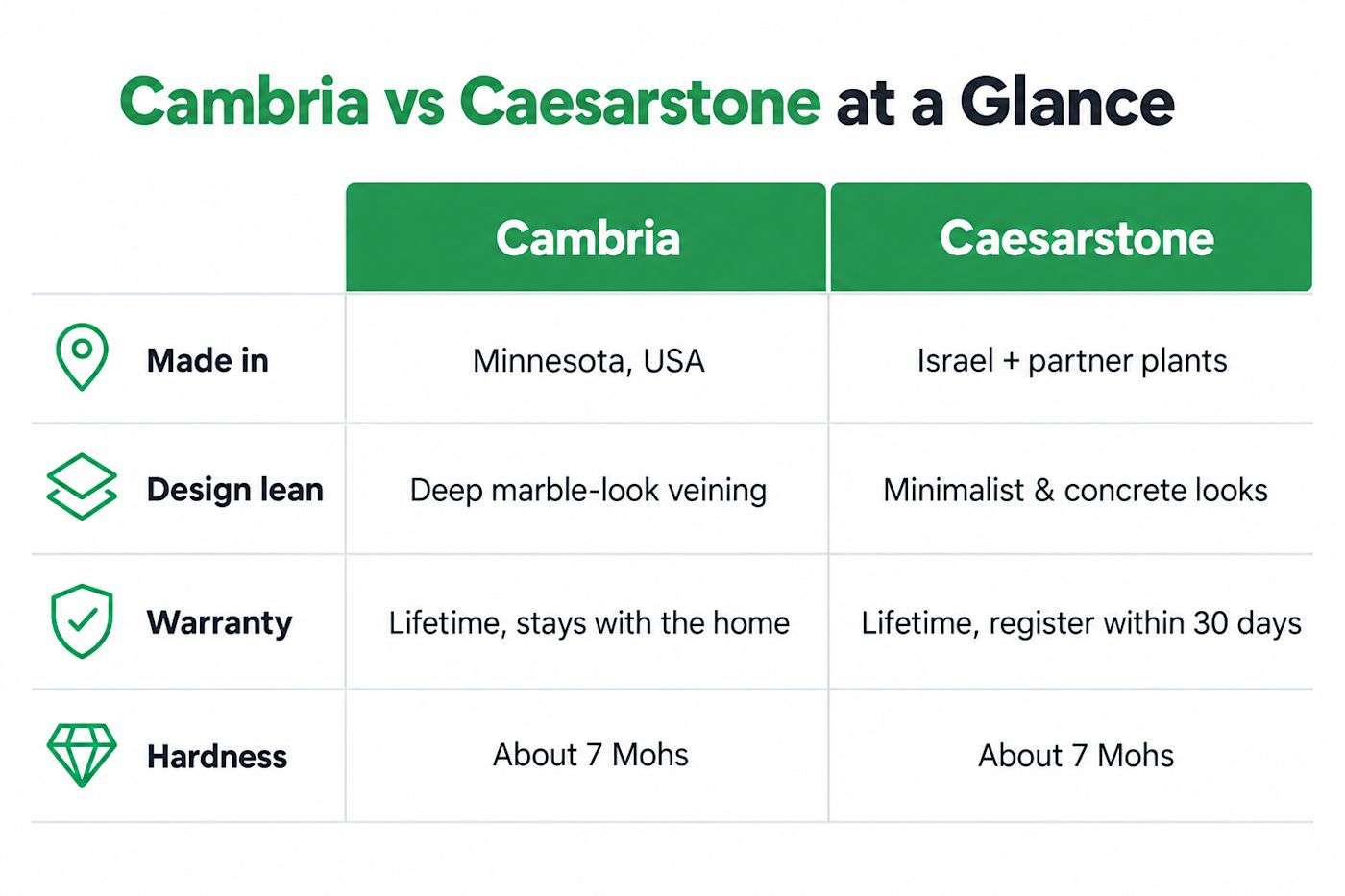
Pattern and color range: Cambria's catalog vs Caesarstone's
Both brands publish large catalogs, and the specific colors available vary by region and change every year. The bigger difference is direction: Cambria has invested heavily in deep, irregular veining meant to mimic high-end marble, while Caesarstone's newer releases skew toward flat, matte, concrete-adjacent surfaces aimed at contemporary and industrial kitchens.
For a kitchen where the counter needs to read as a natural-stone statement piece, Cambria's veined collections carry more depth and movement slab to slab. For a kitchen built around a minimalist or Scandinavian palette, Caesarstone's solid and lightly textured colors integrate without competing with cabinetry.
Cambria: veined marble-look designs and the most popular patterns
Brittanicca is Cambria's best-known pattern, a warm white background with soft gray-gold veining modeled on Calacatta marble; it anchors a family of related colorways including Brittanicca Warm. Ella follows a similar Calacatta direction with finer veining, and Skara Brae offers a darker, more dramatic movement for buyers who want contrast rather than a soft palette. The catalog's center of gravity sits firmly in marble-look, high-veining territory, which is why Cambria is the default pick when the countertop is meant to be the room's focal point.
Caesarstone: minimalist and concrete-look finishes
Caesarstone covers ground Cambria largely skips: flat concrete looks (the Metropolitan collection), industrial grays, and understated solids that read closer to poured concrete or raw stone than to polished marble. Statuario Maximus, part of Caesarstone's marble-inspired line, competes directly with Cambria's Calacatta-style patterns, but the bulk of the catalog stays in quieter, less veined territory than Cambria's.
Cambria and Caesarstone warranties compared
Both companies describe their residential warranty as lifetime, but "lifetime" means different things once you read the exclusions. The comparison below covers length, transferability, and what voids coverage. Always read the current warranty document for your slab before you sign.
| Warranty feature | Cambria | Caesarstone |
|---|---|---|
| Length | Lifetime limited | Lifetime limited (residential) |
| Transferable to new owner | Yes, the lifetime warranty stays with the home for the new owners | Only as a prorated 10-year limited warranty (capped at 10 years from installation), and only if the original owner registered it |
| Requires certified installer | Yes, a Cambria-authorized fabricator and installer | Yes, a Caesarstone Certified Fabricator, plus registration within 30 days of installation |
| Common exclusion | Damage from heat, impact, or improper sealants/adhesives | Damage from heat, impact, or unauthorized sealers/chemicals |
Cambria's transferability is a genuine point of difference for resale-minded buyers; Caesarstone's registration window is the detail owners miss most often.
Cambria: lifetime limited warranty, transferable terms
Cambria's warranty is transferable, meaning it follows the countertop to the next owner rather than expiring at the sale. Coverage stays valid as long as the slab is fabricated and installed by an authorized Cambria fabricator and maintained with the cleaning and sealant guidance Cambria publishes; using incompatible adhesives or sealers during a repair can void the claim.
Caesarstone: limited lifetime warranty and its registration condition
Caesarstone's residential warranty is also described as lifetime, but it is conditioned on registering within 30 days of installation and on the work being done by a Caesarstone Certified Fabricator. If the home sells, the next owner gets a prorated 10-year limited warranty, not the full lifetime coverage. The exclusion that catches owners most often is heat damage: a pot pulled straight from the stove onto the slab, with no trivet, is treated the same way under Caesarstone's terms as it is under Cambria's, as ordinary misuse rather than a manufacturing defect.
Cambria vs Caesarstone price per square foot installed in Sacramento
Installed price depends on slab price group, edge detail, and cutout count, and local rates in the Sacramento area will differ from national averages quoted by manufacturers.
| Cost driver | Cambria | Caesarstone |
|---|---|---|
| Installed price per sq ft, Sacramento | $80 to $150+ | $65 to $130+ |
| 30 sq ft kitchen counter, installed | $2,400 to $4,500+ | $1,950 to $3,900+ |
| Thickness options | 1cm, 2cm, or 3cm | 2cm or 3cm (varies by color) |
| Typical price spread | Several price groups, veined designs priced highest | Several price groups, solids priced lowest |
These are planning ranges, not quotes. Get a fixed-price quote on your actual layout before budgeting off any published range, because the numbers move with slab availability and the specific pattern you choose. GVD Renovations provides a free, detailed fixed-price proposal covering the full scope of a quartz installation, so the total you approve before work starts is the total you pay.
What drives the total: slab price group, edge profile, and thickness
Cambria prices designs into groups, and the heavily veined patterns like Brittanicca sit in higher groups than solid colors, which widens the gap between a basic Cambria slab and a premium one more than the equivalent gap in Caesarstone's lineup. Thickness matters too: a 3cm slab uses roughly 50% more material than 2cm, so choosing 2cm in either brand lowers the slab cost (check that your color is offered in that thickness). Edge profile (a simple eased edge versus a built-up ogee or waterfall) and cutout count (sink, cooktop, outlets) add to the fabrication labor regardless of brand, often more than the difference between the two brands' base slab price.
Why Cambria costs more than Caesarstone
Cambria usually prices higher, and the main reasons are positioning and design. It is made in the US, which carries higher labor and facility costs than Caesarstone's overseas production, and its catalog leans on complex, deeply veined designs that sit in the top price groups. Compare like for like, though: a Caesarstone marble-look slab and a Cambria marble-look slab are often closer in price than the brand averages suggest.
How Cambria and Caesarstone hold up to Sacramento Valley conditions
Sacramento Valley summers regularly push past 100°F with direct UV exposure through west-facing kitchen windows, and both Cambria and Caesarstone contain polyester resin that can fade or yellow under prolonged, direct UV, which is why neither manufacturer rates their quartz for outdoor installation. Indoor kitchen use away from direct sun exposure is unaffected by this limitation, so it rarely changes the brand decision for a typical interior kitchen remodel.
Local sourcing and fabrication matter more than brand chemistry for how the countertop performs over time, because a slab fabricated with poorly supported seams or undersized cutout reinforcement can crack regardless of whether it's Cambria or Caesarstone. A Sacramento-area fabricator familiar with both brands' handling requirements, support spans for overhangs, and seam placement will determine durability as much as the slab itself does.
How to choose between Cambria and Caesarstone for your kitchen
1. Set your style direction first
If you want a dramatic veined focal point, start with Cambria's Brittanicca or Ella family. If you want a quiet, modern backdrop, start with Caesarstone's Metropolitan collection or its solid whites.
2. Set a budget anchor
Price out a 2cm Caesarstone slab in a solid color as your floor and a 3cm Cambria veined slab as your ceiling, then see where your kitchen's square footage lands between them.
3. Check resale plans
If you expect to sell, Cambria's coverage transferring to the new owners is a real selling point; Caesarstone's transfers only as a prorated 10-year limited warranty, and only if you registered it.
4. Confirm thickness against your cabinet specs
A 2cm slab in either brand usually needs a plywood substrate or extra support under overhangs that a 3cm slab doesn't, which changes cabinet prep cost.
Get two fixed-price quotes, one per brand, from the same fabricator so labor, cutouts, and edge profile are held constant and only the slab cost varies.
A buyer renovating a long-hold family home with a statement island tends to lean Cambria for the pattern and the transferable warranty. A buyer renovating a rental or a flip, or one furnishing a minimalist kitchen, tends to lean Caesarstone for the lower entry price and the quieter palette.
Where to buy and who installs each brand near Sacramento
- Showrooms: See Cambria and Caesarstone slabs in person at a local fabricator showroom or a design studio that stocks both lines; GVD Renovations runs a design showroom in Rocklin (6848 Five Star Blvd #6) where you can compare Cambria and Caesarstone slabs and finishes side by side with the design team before committing, alongside cabinetry and tile samples.
- Authorized dealers: Both brands sell only through certified fabricator networks, not direct to homeowners, so confirm a dealer's certification before ordering a slab.
- Fabricators near Sacramento and Elk Grove: Installers experienced with both brands' seam and support requirements are worth seeking out specifically; ask for the brand name on their certification, not just "quartz experience."
The fabricator matters more than the brand for how the finished counter performs, because seam placement, cutout reinforcement, and polish quality are entirely a function of the installer's skill, not the manufacturer's. GVD runs every project with one accountable team and a single dedicated project manager, because coordination between template, fabrication, and install is what determines seam placement and finish quality more than the brand of slab. Before signing, ask a fabricator three things: which brands they're certified to install, whether their quote is fixed-price or subject to change after template, and what their standard support span is for an unsupported overhang on your chosen thickness.
What decides the choice: warranty, pattern range, finish, and local price
- Warranty terms: Cambria's lifetime coverage stays with the home for new owners. Caesarstone's depends on registration within 30 days and transfers only as a prorated 10-year warranty.
- Pattern range: Cambria's catalog leans toward deeper marble-look veining. Caesarstone's catalog leans toward minimalist and concrete-look designs.
- Finish options: Caesarstone offers a broader lineup of textured finishes. Cambria's range stays narrower, built mostly around polished and matte looks.
- Local installed price: What matters is the number a Sacramento fabricator actually quotes. The manufacturer's published range rarely matches that number.
Installed price in Sacramento matters more than the slab's published sticker price. Labor, cutouts, and edge profile often account for a larger share of the final bill than the gap between the two brands' base material cost.
Durability in a kitchen: scratch, stain, and heat resistance
Scratch resistance
Both brands rate near 7 on the Mohs hardness scale because both are roughly 90 to 95% crushed quartz, the same mineral that gives natural quartz its hardness; a kitchen knife (around 5.5 on the Mohs scale) will not scratch either surface under normal use.
Stain resistance
The non-porous resin matrix on both brands resists wine, coffee, and oil without sealing, so neither brand stains more easily than the other in day-to-day use.
Heat resistance
Neither Cambria nor Caesarstone should take a pan straight off the stove, because the resin in both can discolor or crack from heat and sudden temperature change; always use a trivet regardless of brand. For daily kitchen wear, both hold up comparably over a decade of normal use, and the brand you choose won't change how the counter looks in year eight so much as how it was fabricated and cared for.
Sealing and daily maintenance for both brands
Sealing
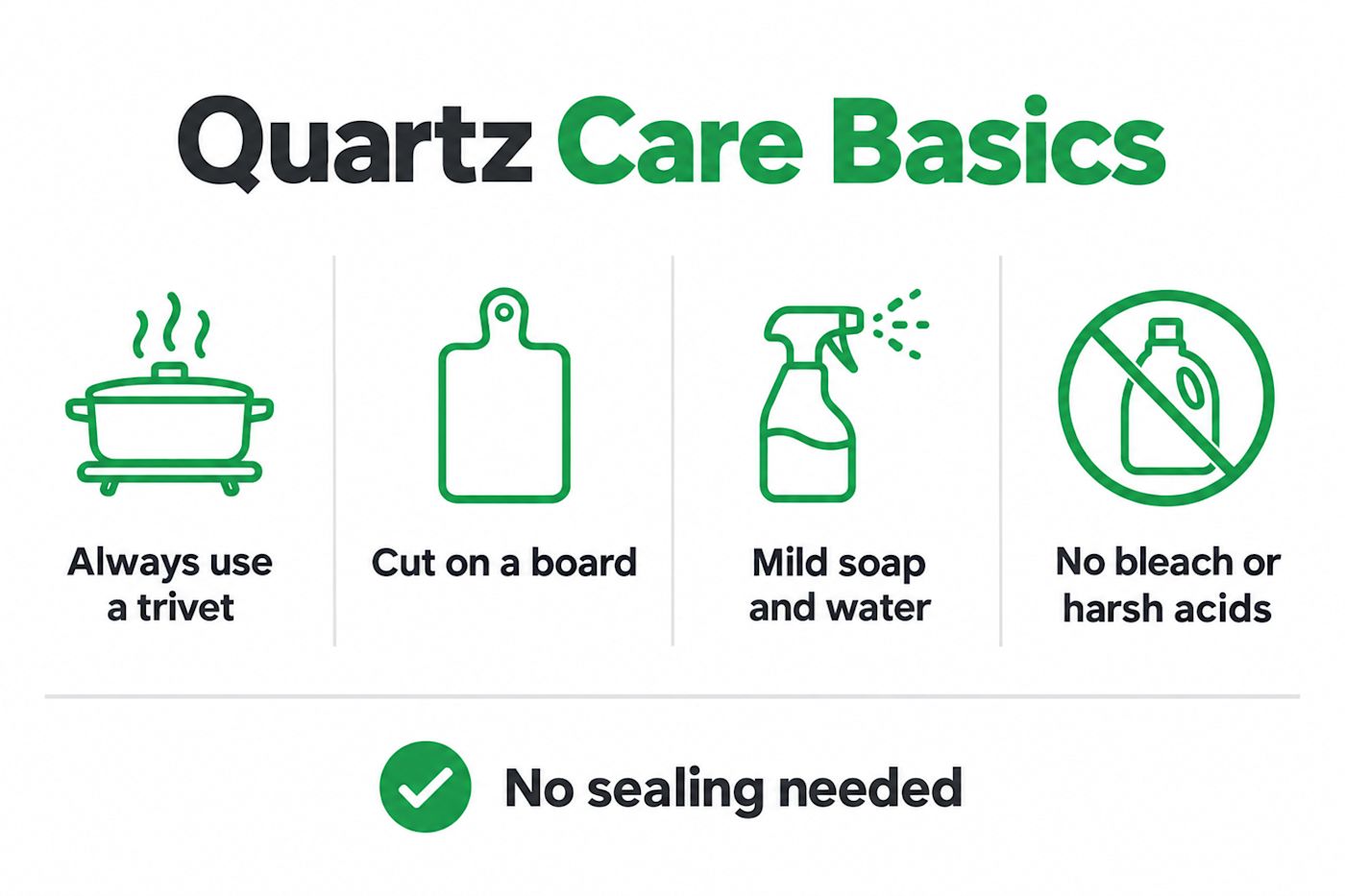
Both Cambria and Caesarstone are non-porous engineered surfaces and never need sealant, unlike granite or marble.
Daily cleaning
Clean daily with mild soap and water or a non-abrasive quartz-safe cleaner; avoid anything branded as a "heavy-duty degreaser" with high pH, which can dull the resin finish over time. Avoid bleach-based and highly acidic cleaners (undiluted vinegar, citrus-based degreasers) on both brands, because sustained acid contact can etch the resin surface.
Protecting the finish
Use a cutting board, not the counter directly, since both surfaces are scratch-resistant but not scratch-proof under a blade's full edge pressure. Keep trivets by the stove, since heat protection, not stain or scratch protection, is the maintenance habit both brands actually require.
Slab sizes, thickness, and what they mean for your layout
The table below compares standard dimensions; use it to decide whether your island or run needs a jumbo slab to avoid a seam.
| Dimension | Cambria | Caesarstone |
|---|---|---|
| Thickness options | 1cm, 2cm, 3cm | 2cm, 3cm (varies by color) |
| Standard slab size | 122" × 55.5" | 120" × 56.5" |
| Jumbo slab size | 132" × 65.5" | 131.5" × 64.5" |
| Best thickness for kitchen counters | 3cm (2cm with substrate) | 3cm (2cm with substrate) |
A jumbo slab matters when an island run or a wall-to-wall counter exceeds roughly 9 to 10 feet, since that's where a standard slab forces a visible seam; confirm jumbo availability for your specific pattern before finalizing a layout, since not every color ships in the larger format. For a standard kitchen counter, 3cm is the safer choice in either brand because it doesn't need a plywood substrate under overhangs the way 2cm does.
Finish options: polished, honed, and textured surfaces
- Polished: the standard glossy finish on both brands, and the easiest to keep clean since the smooth surface doesn't trap residue in a texture.
- Matte/honed: Cambria offers a matte finish on select colors that mutes the gloss without changing the stain resistance of the underlying material.
- Suede and concrete-look textures: Caesarstone's textured finishes, found across its Metropolitan and concrete-look colors, add a tactile surface that shows fingerprints and water spots more readily than a polished finish, which means slightly more frequent wiping in a busy kitchen.
Frequently asked questions about Cambria and Caesarstone
Is Caesarstone the same as quartz?
Caesarstone is engineered quartz, typically around 90 to 93% natural quartz crystal bound with polyester resin and pigment, which is the same manufacturing approach Cambria and most major quartz brands use. It is not a single natural mineral the way granite or quartzite is.
Is Cambria quartz worth the extra cost?
For a buyer who wants deep, marble-like veining and a lifetime warranty that stays with the house, Cambria's premium over Caesarstone buys a real difference in pattern depth and resale documentation. For a buyer prioritizing budget over pattern drama, that premium is harder to justify since the underlying hardness and stain resistance are comparable to Caesarstone's.
Is Caesarstone porous?
Caesarstone is non-porous, meaning liquids don't soak into the surface the way they can with unsealed granite or marble. Non-porous does not mean stain-proof forever; pigmented liquids left to sit for extended periods can still discolor the resin surface if not wiped up.
Where is Cambria quartz made?
Cambria manufactures its slabs in Minnesota, making it one of the few major quartz brands produced in the United States. That matters to buyers who want to avoid the longer freight timelines and batch variability that can come with slabs shipped from overseas facilities.
Is Caesarstone less expensive than granite?
Caesarstone's installed cost generally overlaps with mid-range granite rather than undercutting it outright; the real advantage over granite isn't a lower price, it's skipping the sealing granite requires.
Get a fixed-price quote for Cambria or Caesarstone in Sacramento
The next step is a firm, fixed-price proposal on your actual layout, not a per-square-foot range pulled from a manufacturer's website. GVD Renovations offers a free in-home or in-showroom consultation at its Rocklin showroom (6848 Five Star Blvd #6), where you can see Cambria and Caesarstone slabs side by side, get a detailed fixed-price proposal, and have a dedicated project manager coordinate the fabrication and install from template to final walkthrough.
GVD holds a 4.9/5 rating across 921+ verified reviews and an A+ BBB rating, backed by California contractor license number 989637 and full liability and workers' compensation insurance.
Reviewed by our team at GVD Renovations, a licensed general contractor. While we strive for accuracy, project specifics vary — contact us for a personalized assessment. Product details, specifications, or warranties may have changed since publication. Brand and product mentions reflect our professional opinion, not endorsements or guarantees.
Tags: cambria vs caesarstone, quartz countertops, cambria, caesarstone, sacramento,
Written by Paul Kho