Bathroom Remodeling in Lincoln
Bathroom remodels in Lincoln and nearby Sun City Lincoln Hills and Sheridan: one GVD project manager, any required Placer County permits handled, and one fixed price in a detailed proposal.
Lincoln Bathroom Transformations
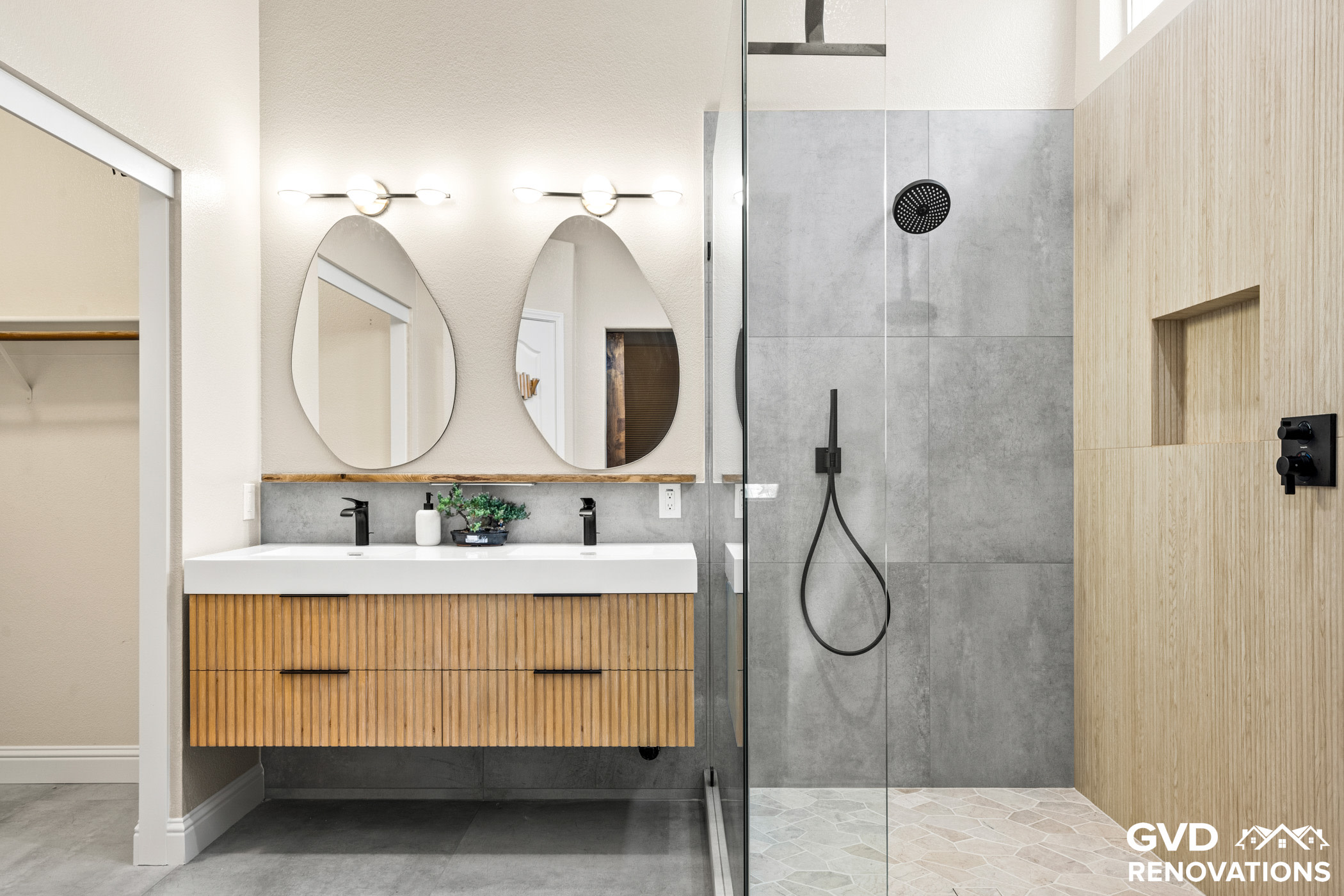
See real GVD bathroom remodels across Lincoln and nearby Northern California communities — tub-to-shower conversions, walk-in showers, and full gut renovations, each priced in a detailed fixed-price quote.


Tap images to enlarge
See More Recent Projects →A Lincoln bathroom remodel, at a glance
What most Lincoln homeowners can expect from a GVD bathroom remodel, before the details of their own room are measured.
Lincoln Bathroom Before & After Gallery
A look at real bathroom remodels GVD has delivered around Lincoln.


Key Takeaways
- Old cast-iron or galvanized drain lines and a failing subfloor are the two findings that most often move a bathroom budget after demolition starts.
- One project manager stays with the job from the first site visit through the final walkthrough, coordinating every trade.
- Tile color and veining vary between production lots, so buying one batch with 10 to 15 percent overage prevents a mismatched patch later.
- Replacing fixtures in their existing locations generally does not need a permit, while moving a drain line, adding a circuit, or relocating a wall typically does.
- Most projects run 2 to 8 weeks, with permitting at the front end and material lead time as the two most common sources of delay.
What a GVD bathroom remodel covers
In Lincoln, GVD takes on bathroom projects from same-footprint updates to complete layout changes with relocated drains and supply lines. One project manager carries the job from the first measurement to the final walkthrough, and permitting, where the scope calls for it, goes through the City of Lincoln or Placer County. That includes homes around Twelve Bridges and Catta Verdera, and we also work in nearby Sun City Lincoln Hills and Sheridan.
Plumbers, tile setters, electricians, and carpenters work as one coordinated team from quote to walkthrough, so nobody is waiting on a trade that answers to a different company.
GVD is family-owned, licensed in California under #989637, and carries full liability and workers' compensation insurance.
How much a bathroom remodel costs in Lincoln
The subfloor beneath the old tile and the material of the existing drain line are the two concealed conditions that move a bathroom budget after demolition begins. We assess both before quoting so the firm total price reflects what is actually behind the walls, not a guess corrected on site.
For a closer look at what each tier includes, see the pricing section of our main bathroom remodeling page.
A contingency of 15 to 20 percent is worth holding back on an older home, because what is behind the tile cannot be priced until the tile is off.
Bathrooms in Sun City Lincoln Hills and Twelve Bridges get specified against the house they are in, since original fixtures, drain material, and subfloor condition all vary by property. The usual findings are corroded cast-iron or galvanized drains and a subfloor softened by years of slow leaks. Neither shows up until the floor is open, which is why the budget should cover what the room needs structurally before it is divided among fixtures and tile.
When quotes look wildly different, check which tier each one assumes first. A focused-update price and a layout-change price are not pricing the same project.
Quartz versus tile for a shower surround
The surround decision is a maintenance decision more than an appearance one, since both options can be made to look good and only one has grout.
| Surround | Relative installed cost | Maintenance | Best suited to |
|---|---|---|---|
| Quartz or solid-surface slab | Highest of the three | Wipe down; no grout to reseal | Owners prioritizing low upkeep over pattern choice |
| Ceramic or porcelain tile | Lowest | Periodic grout resealing | The widest range of pattern, color, and format options |
| Natural stone tile | Between the two | Sealing on a regular cycle | A specific stone look, accepting the upkeep that comes with it |
A slab surround goes up in a few large pieces with very few seams, which is why it costs more to fabricate and install and also why it is easier to live with: there is no grout line for mildew to settle into. Tile costs less upfront and gives far more design range, but the grout needs periodic resealing.
Tub-to-shower conversion or a full bathroom remodel?
The question worth settling before booking anything is whether the tub is the problem or whether the tub is just the most visible symptom.
The deciding question is whether the problem is the tub or the room. A conversion replaces the tub with a walk-in shower and nothing else; a full remodel replaces every surface and can relocate fixtures. Solving a tub problem with a full remodel overspends, and solving a room problem with a conversion usually means paying twice.
Our shower replacement page for Lincoln covers conversions and walk-in builds in depth, including what each route costs on its own.
Do you need a permit to remodel a bathroom in Lincoln?
Permit requirements turn on scope, so the answer for any specific bathroom comes from the City of Lincoln or Placer County rather than from a general rule about remodels.
Like-for-like replacements, such as a new toilet or vanity in the same spot, usually skip permitting. Relocating drains, adding electrical circuits, moving walls, or converting to a curbless shower generally bring a permit, with inspections at rough-in before the walls close and again at final.
If the work calls for a permit, GVD files it with the City of Lincoln or Placer County and coordinates each inspection, so you are not tracking it yourself.
The order a bathroom remodel should be done
Every step below either has to cure, has to be inspected, or has to be confirmed before the next one starts. That is what sets the calendar.
Getting the order wrong is expensive: finished tile over an uninspected rough-in may have to come out, and paint applied before tile work usually gets redone.
How long a bathroom remodel takes
Plan on 2 to 8 weeks of project time. Where a specific bathroom lands inside that depends far more on whether the plumbing moves than on the size of the room.
Three things stretch a schedule: waiting on permit review, waiting on special-order tile or slab, and repairing what demolition uncovers, such as old drain lines or dry rot.
Choosing a bathroom remodeler
Most bathroom complaints trace to scope that was never written down rather than to workmanship, which makes the detailed digital proposal the thing to scrutinize.
Verify the license, then have two or three contractors see the room in person. The items that move a bathroom price, such as drain material, subfloor condition, and venting, can only be judged on site.
Verify the license and insurance
Look up the license number at cslb.ca.gov before signing. Confirm it is active, check for disciplinary actions, and ask for proof of liability and workers' compensation coverage, since an uninsured crew shifts injury liability onto the homeowner.
Red flags to watch for
- A same-day-only price that expires when the estimator leaves.
- No detailed scope, just a price.
- A large deposit demanded before permits are filed or materials ordered.
- Hesitation when you ask for the license number or proof of insurance.
- Silence about permits on a job that obviously needs one.
Why Lincoln homeowners choose GVD Renovations
We quote both focused updates that keep the existing footprint and full layout changes that move fixtures and walls, so the recommendation follows what your room needs rather than a single product line a national franchise has to sell. In neighborhoods like Sun City Lincoln Hills, Twelve Bridges, Lincoln Crossing, and Catta Verdera, an architectural review or HOA approval can shape what a remodel is allowed to do, and we plan for that up front. Our in-house team self-performs most of the demolition, plumbing, waterproofing, and tile, so one accountable team stands behind the work from quote to walkthrough.
One project manager stays with your bathroom from the first visit to the final walkthrough, and the company carries an A+ Better Business Bureau rating.
We have taken bathroom projects through plan review with the City of Lincoln or Placer County and neighboring jurisdictions, so when a permit is required our submittals match what inspectors expect.
Selections happen at our showroom at 6848 Five Star Blvd #6 in Rocklin, about 9 miles from Lincoln (roughly a 15-minute drive), where you can compare tile, slabs, and vanities side by side before anything is ordered.
Recent Bathroom Remodels Near Lincoln
Serviced ZIP Codes: 95648

4.6/5

4.9/5

A+

5/5

5/5

5/5

5/5

4.8/5

5/5
We are fully insured with worker's compensation and general liability insurance to safeguard you and your home during our work.


GAF Certified Roofing Contractor


2025 James Hardie Service Excellence Award


LP Certified Installer Certificate


Angie's List Super Service Award

VSI Certified Installer

Best of Houzz 2020 Service Award


Financing made simple
- Fast application process
- Flexible payment options
- Check eligibility in minutes
Financing is offered through third-party lenders. Approval, rates, and terms depend on credit profile. Not all applicants qualify.

Checking eligibility will not impact your credit score
Watch What Our Lincoln Clients Have to Say
Trusted by Thousands of Homeowners Across Northern California


Bathroom Remodeling Near Lincoln
We bring the same crews, materials, and workmanship to every community around Lincoln.
Frequently Asked Questions
about Bathroom Remodels in Lincoln
How much does a bathroom remodel cost in Lincoln?
Most GVD bathroom projects in Lincoln fall into three tiers: a focused update at $18,000 to $30,000, a mid-range remodel at $30,000 to $55,000 (where most projects land), and a primary bath with a layout change from $55,000 to $100,000 and up. Whether the plumbing moves is the biggest price driver.
How long will my bathroom be out of service?
Typically 2 to 8 weeks of work, depending on scope. Jobs that need rough-in inspections, custom materials, or repairs behind the walls sit at the longer end.
Do I need a permit to remodel a bathroom in Lincoln?
Not always. Like-for-like fixture swaps generally skip permitting, while relocated plumbing, new electrical circuits, and framing changes generally need one. GVD handles any required permits through the City of Lincoln or Placer County.
Is a tub-to-shower conversion enough, or do I need a full remodel?
If the tub is the only problem, a conversion fixes it for a fraction of the cost. If the layout, vanity, or flooring is also failing, a full remodel avoids paying twice. We quote both, so the recommendation follows the room.
Why budget extra beyond the bathroom quote?
Concealed conditions, mainly old drain lines and subfloor damage, are only visible after demolition. A 15 to 20 percent reserve covers them, and older homes use it more often.
Can I see materials before my bathroom remodel starts?
At our Rocklin showroom on Five Star Blvd. You can compare tile, slabs, vanities, and fixtures in person and lock in selections before construction starts.