

Some roofing problems start long before the first shingle comes off: in a bid that leaves out the tear-off, a contract that asks for a third of the price up front, or a salesperson who shows up the morning after a storm. This guide covers the roofing contractor red flags to watch for in California, which ones actually break state law, and what to do when you spot one.
Walk away from a roofer who has no active CSLB license with the C-39 Roofing classification, no workers' comp, asks for more than $1,000 or 10% down (whichever is less), wants payment ahead of the work, asks you to pull the permit, or offers to "cover" your insurance deductible. Treat a bid far below the others, a vague scope, door-to-door storm sales and sign-today pressure as reasons to slow down and get answers in writing.
Red flags at a glance
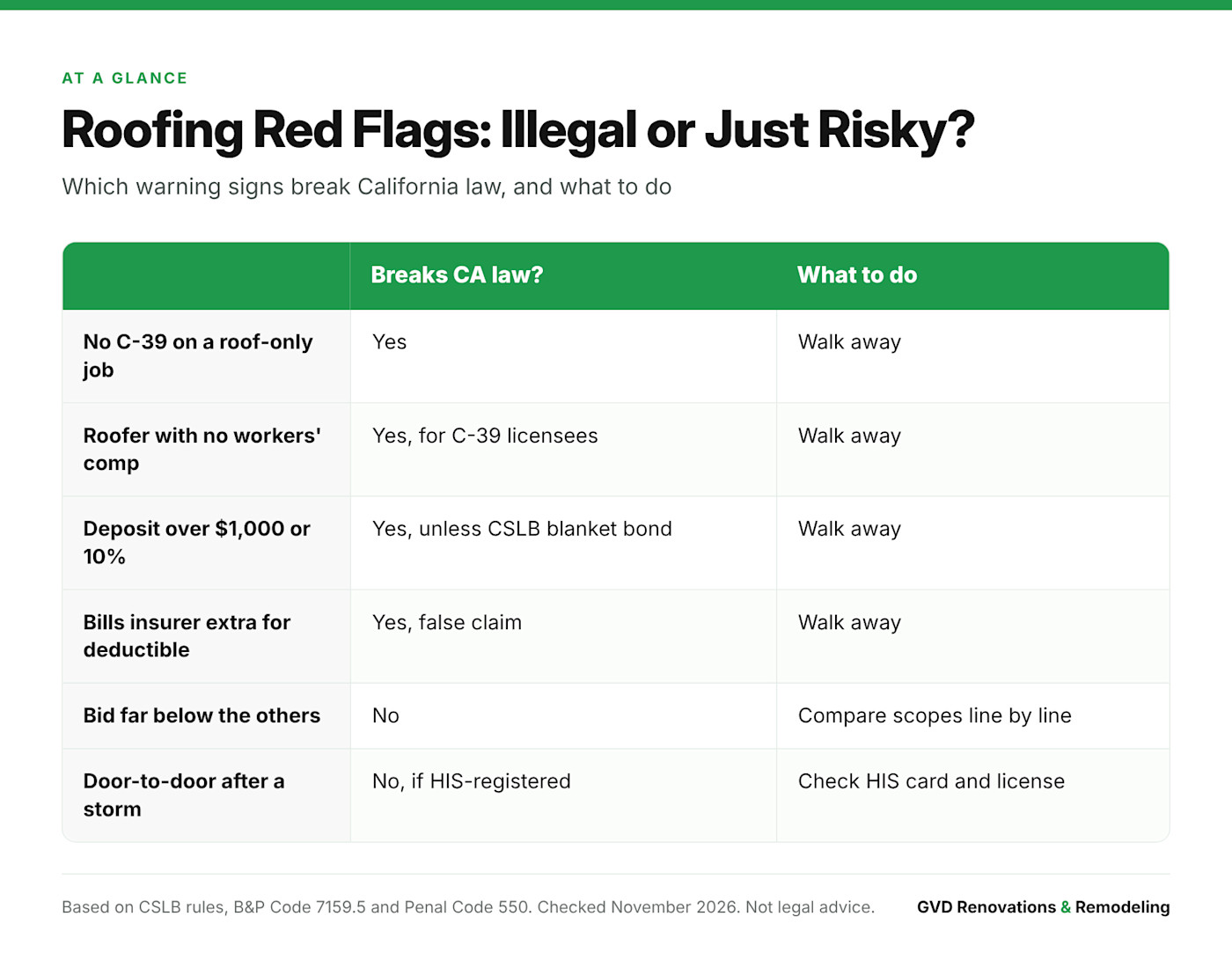
Not every warning sign is equal. Some are violations of California law and end the conversation. Others are reasons to ask harder questions before you sign.
| Red flag | Breaks California law? | What to do |
|---|---|---|
| No active license, or wrong classification for a roof-only job | Yes | Walk away |
| Roofer with no workers' comp | Yes, for C-39 licensees | Walk away |
| Deposit over $1,000 or 10%, whichever is less | Yes, unless a CSLB blanket bond is on file | Walk away |
| Payment ahead of work or materials | Yes | Refuse; pay only for work done |
| Offer to bill your insurer more to cover the deductible | Yes, it is a false claim | Walk away |
| Bid far below the others | No | Compare scopes line by line |
| Door-to-door after a storm | No, but the seller must be registered | Check the HIS card and license |
| Sign-today pressure | No | Wait and get other bids |
Red flags in the bid
A price far below the other bids
A low price isn't illegal, but it usually means something is missing. The common gaps are the tear-off, new flashing, a leak barrier in the valleys, the permit, and a price for replacing rotted sheathing. Some low bidders plan to make up the difference with change orders once your roof is open and you have no choice.
Ask the low bidder to put the missing items in writing. If they won't, or the price jumps, you've learned what you needed to know.
A vague scope
"Remove and replace roof, architectural shingles, standard underlayment" is not a scope. A bid with no brand, product line, underlayment type, flashing plan or ventilation plan lets the contractor install whatever is cheapest that week. It also makes it impossible to hold them to anything later. Our checklist of questions to ask a roofing contractor lists what a complete roofing scope should name, with good and bad answers for each.
"You don't need a permit for this"
Most roof replacements in the Sacramento area do need one. A roofer who skips it may be avoiding an inspection, or may not be able to pull permits at all. Unpermitted work can also surface when you sell the house. See roof replacement permits in Sacramento for how the process works where you live.
A push to replace a roof that may only need repair
CSLB warns about a classic scare tactic: a free inspection followed by a list of serious problems that lead to unnecessary, overpriced work. If one roofer says replace and the others say repair, ask for photos of the damage. Our guide on whether to repair or replace your roof explains the thresholds that actually decide it.
Red flags in the contract
A deposit over the legal limit
Under Business and Professions Code 7159.5, the down payment on a home improvement contract can't exceed $1,000 or 10% of the price, whichever is less. "We need half up front to order materials" is not an exception. The only exception is a contractor who has a qualifying blanket performance and payment bond on file with CSLB, and very few do. You can ask, and you can check.
Payments that run ahead of the work
The same law says a contractor can't request or accept payment that exceeds the value of the work performed or materials delivered. A schedule that asks for 50% on the day the crew arrives, or full payment before final inspection, breaks that rule. Each progress payment should be tied to something you can see, like materials on site or the tear-off done.
Cash only, or no written contract
A home improvement contract in California must be in writing and contain specific items, including the contractor's name, address and license number, the salesperson's name and registration number if one was involved, a description of the work and significant materials, a schedule of progress payments, approximate start and completion dates, a mechanics lien warning, statements about general liability and workers' comp coverage, and a notice of your right to cancel. A one-page invoice or a handshake deal is missing most of that. Cash-only terms leave you no record if the job goes wrong.
Blank spaces and verbal promises
Never sign a contract with blanks for price, dates or materials. The law says you are entitled to a completely filled-in copy before work begins. If the salesperson promised a better shingle or a longer warranty, it has to be in the contract, not in your memory of the conversation.
Red flags in how they sell
Storm chasers at the door
After wind or heavy rain, out-of-area crews often canvass neighborhoods offering free roof inspections. The California Department of Insurance warns about fly-by-night contractors and door-to-door scammers after disasters, and specifically about door-to-door salespeople with unrealistically low estimates. Signs to watch for: no local office address, an out-of-area phone number, a business that was registered recently, and a crew that wants to start right away.
A door knock isn't illegal on its own. But anyone who sells home improvement contracts for a licensed contractor must be registered with CSLB as a Home Improvement Salesperson (HIS), with a few exceptions such as company officers. Ask to see the HIS pocket card, then look up both the salesperson and the contractor's license on the CSLB website.
Leftover materials and sign-today prices
CSLB describes a common roofing scam: someone offers a steep discount using "leftover" materials from a nearby job, collects money and disappears. A price that expires when the salesperson walks out the door is the same pressure in a different form. Shingle prices don't change overnight, and a legitimate estimate gives you time to check the license and get other bids. If you're told you must sign today to get on the schedule, our post on the best time to replace a roof in Sacramento explains how season affects scheduling so you can plan without being rushed.
"Can you pull the permit?"
If the roofer asks you to pull the permit as an owner-builder, ask why. It can mean the contractor can't pull one, or is trying to keep their crew off the record. As an owner-builder you take responsibility for the job, and CSLB warns that you could be asked to pay for worker injuries through your homeowner's policy or face lawsuits.
Insurance claim and deductible red flags
"We'll take care of your deductible"
The pitch usually sounds like a favor: the roofer bills your insurance company a higher price than you are really paying, so the extra covers your deductible and the roof is "free." That means a false number goes to your insurer. California Penal Code 550 makes it a crime to knowingly present a false or fraudulent insurance claim or to make a statement in support of a claim that contains false or misleading information about a material fact. If you sign that paperwork, you are part of it.
A legitimate roofer documents the damage honestly, works with the adjuster on the real scope, and expects you to pay your deductible.
A roofer who wants to "handle the claim" for you
Be careful with any contractor who asks you to sign a form letting them negotiate with your insurer. In California, people who negotiate claims on a homeowner's behalf for pay are public adjusters, and the Department of Insurance licenses them. Your insurer provides its own adjuster at no charge, and the Department suggests trying to settle with your insurer before hiring anyone else.
Contracts signed right after a disaster
California law gives extra protection when a declared disaster damages your home. Under the Home Solicitation Sales Act, a repair contract signed before midnight of the seventh business day after the damage can be void unless an exception applies, and you otherwise have until midnight of the seventh business day after signing to cancel. Contracts for property damaged in a declared emergency must include a seven-day right to cancel notice.
License and insurance red flags
These are the deal-breakers you can find yourself on the CSLB license record in a few minutes:
- Status not active: expired, suspended or revoked licenses can't contract for your roof.
- No C-39 on a roof-only job: a B General Building license covers roofing only on a project with at least two other unrelated trades, or if the roofing is subcontracted to a licensed specialty contractor. A painting or drywall license never covers it.
- A workers' comp exemption on a roofing license: CSLB requires every active C-39 licensee to carry workers' comp, even with no employees, and roofers can't file the exemption.
- No contractor bond, or recent disciplinary actions: every active license needs a $25,000 bond.
- A name that doesn't match: the business on the bid should be the business on the license.
An unlicensed person can only take jobs under $1,000 in labor and materials combined, and only with no employees and no permit required. A roof replacement is never one of those jobs.
What to do if you see one
Before you sign
Don't negotiate around a legal red flag. If the license, workers' comp or deposit is wrong, end the conversation. For softer warning signs, ask for the missing details in writing and compare against two other complete bids.
If you already signed
- Cancel in writing if you are still in the window. You generally have three business days after signing a home improvement contract to cancel, and five business days if you are 65 or older. A letter or email stating you don't want to be bound is enough. CSLB advises not letting work start or permits get pulled during this period.
- Stop paying ahead. Don't make a progress payment for work that isn't done or materials that haven't been delivered.
- Document everything. Keep the contract, receipts, texts and dated photos of the work and any damage.
- Send written notice. Describe the problem and what you want fixed, by a method that gives you proof of delivery.
- File a complaint with CSLB. CSLB investigates complaints against licensed and unlicensed contractors. You can also make a claim against the contractor's $25,000 bond, keeping in mind that several claims can share that limit.
- Report suspected insurance fraud. If someone pushed a deductible scheme or inflated claim, tell your insurer and the California Department of Insurance.
Frequently Asked Questions
What is the biggest red flag with a roofing contractor?
A license problem. If the CSLB record isn't active, doesn't show C-39 Roofing for a roof-only job, or shows a workers' comp exemption on a roofing license, stop there. Everything else in the bid depends on that.
How much deposit can a roofer ask for in California?
No more than $1,000 or 10% of the contract price, whichever is less. The only exception is a contractor with a qualifying blanket performance and payment bond on file with CSLB.
Is it illegal for a roofer to waive my deductible in California?
Billing your insurer for more than the real price to cover your deductible is a false claim, and California Penal Code 550 makes knowingly presenting a false claim a crime. A simple discount isn't fraud, but the claim to your insurer has to reflect the real price.
Are door-to-door roofers legitimate?
Some are. Legitimate salespeople are registered with CSLB as Home Improvement Salespersons and can show an HIS pocket card. Check that registration and the contractor's license before you schedule anything.
Can I cancel a roofing contract after signing?
Usually yes, within three business days for most contracts signed at home, five business days if you are 65 or older, and seven business days for repairs after a declared disaster. Cancel in writing.
Sources
- Business and Professions Code 7159 and 7159.5: required contract contents, down payment cap and progress payment limits
- Contractors State License Board: C-39 Roofing classification, B General Building rules and the $25,000 bond requirement
- CSLB: workers' compensation requirements for C-39 Roofing licensees
- CSLB: Home Improvement Salesperson registration and "Who's Knocking at Your Door?"
- CSLB: "What Seniors Should Know" and home improvement contract warnings (cancellation rights, scams)
- CSLB: AB 2622 bulletin on the $1,000 minor work exemption; owner-builder risks
- California Department of Consumer Affairs Legal Guide K-10: the homeowner's rights to cancel, including disaster repair contracts
- California Department of Insurance: disaster fraud and contractor guides; Penal Code 550 (insurance fraud)
Checked November 2026. This is general information, not legal advice. For a specific dispute, contact CSLB or an attorney.
Hire a Roofer Who Passes the Check
GVD Renovations replaces roofs across the Sacramento region with a written scope, a legal deposit and a payment schedule tied to finished work. Run our license through the CSLB lookup, then request a free estimate on our Sacramento roofing page or visit our Rocklin showroom at 6848 Five Star Blvd #6. Building a deck too? The same habits apply, and our list of decking contractor red flags covers that trade. GVD Renovations Inc. is licensed by the California Contractors State License Board (#989637) and insured.
Reviewed by our team at GVD Renovations, a licensed general contractor. While we strive for accuracy, project specifics vary. Contact us for a personalized assessment. Product details, specifications, or warranties may have changed since publication. Brand and product mentions reflect our professional opinion, not endorsements or guarantees.
Tags: roofing, contractor scams, hiring a contractor, insurance claims, sacramento,
Written by Paul Kho


