

Most roofing bids look alike on the first page: a logo, a price and a promise. The difference shows up when you ask specific questions and check the answers against public records. This guide gives you the questions to ask a roofing contractor in California, what a good answer sounds like, and how to verify each one before you sign.
Ask for the license number and confirm on the CSLB website that it is active and includes the C-39 Roofing classification, a current $25,000 bond and workers' comp coverage. Then ask who pulls the permit, whether the job is a full tear-off, which underlayment and ventilation they plan, what each warranty covers in writing, and how payments are scheduled. A good roofer answers all of it in writing, and the deposit is never more than $1,000 or 10% of the price, whichever is less.
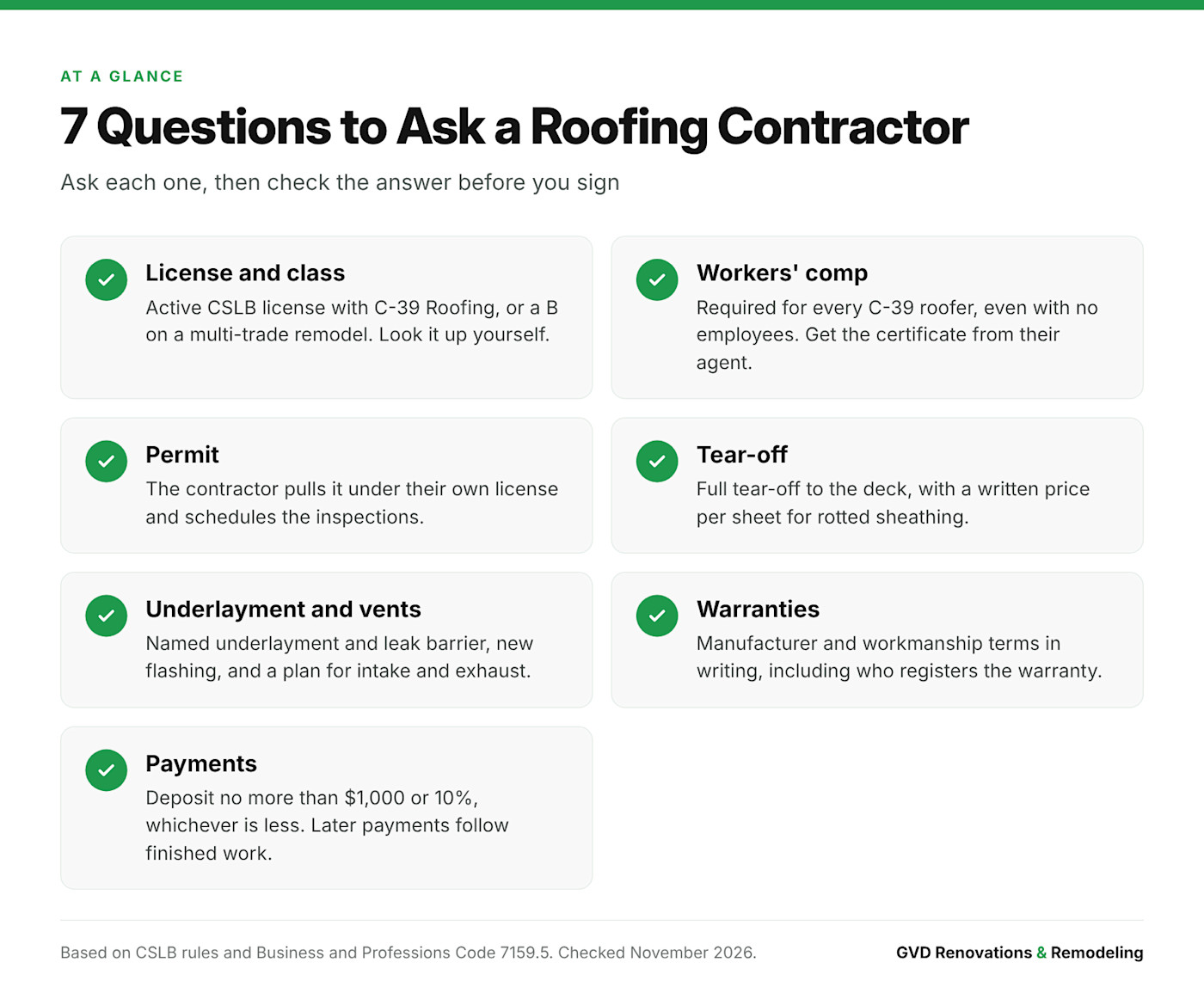
The questions at a glance
Ask the license, insurance and scope questions at the first visit. Save the payment schedule, permit and warranty details for the contract review, when you have the paperwork in front of you.
| Question | A good answer | How to check it |
|---|---|---|
| What is your license number and classification? | An active license with C-39 Roofing (or a B on a multi-trade remodel) | CSLB license lookup |
| Who covers your crew if someone gets hurt? | A workers' comp policy, with a certificate sent by their agent | CSLB record and the insurer |
| Who pulls the permit? | "We do, under our license, and we schedule the inspections." | Your city or county permit portal |
| Is this a full tear-off? | Yes, down to the deck, with a stated price for replacing bad sheathing | Written scope in the contract |
| Which underlayment and ventilation? | Named products and a vent plan for intake and exhaust | Written scope in the contract |
| What do the warranties cover? | Separate written manufacturer and workmanship terms | Warranty documents and registration |
| How do payments work? | Small legal deposit, then payments tied to finished work | Payment schedule in the contract |
License and classification
Ask: "What is your license number, and what classifications does it carry?"
A good answer is a number given without hesitation, printed on the estimate, that matches the business name on the paperwork. Look it up yourself on the CSLB license lookup. You can search by license number, business name or personnel name. Confirm three things: the status is active, the business name matches, and the classifications fit the job.
For a roof-only job, the classification to look for is C-39 Roofing. CSLB defines it as a contractor who installs and repairs surfaces that seal, waterproof and weatherproof structures, using materials like shingles, shakes, roof tile, slate, metal roofing systems and membranes.
A B General Building contractor can include a roof in a bigger remodel. Under Business and Professions Code 7057, a B contractor can only take a prime contract like that if it involves at least two unrelated trades other than framing or carpentry, or if they hold the right specialty license or subcontract the work to a licensed specialty contractor. So if the job is only a reroof and the license shows only a B, ask who will actually do the roofing and under which license.
Ask: "How long have you been licensed under this name?"
The CSLB record shows the original issue date. A long history under one name is a better sign than a new entity, because roof warranties outlast many small businesses. If the license is only months old, ask about the owner's previous companies and look those up too.
Workers' comp and liability insurance
Ask: "Do you carry workers' comp, and can your agent send me the certificate?"
For a roofer, the only acceptable answer is yes. CSLB requires active C-39 Roofing licensees to carry workers' compensation insurance whether or not they have employees, and a roofing contractor cannot file the exemption form. If the CSLB record for a roofing license shows a workers' comp exemption, something is wrong.
Ask the contractor's insurance agent to email the certificate directly to you. A printed copy from a salesperson could be out of date. Call the insurer listed if anything looks off.
Ask: "What general liability coverage do you carry?"
General liability is what pays if a dropped bundle cracks your skylight or an open roof lets rain into the living room. California requires it only for some license types, such as contractors licensed as an LLC, which is exactly why you should ask. A good answer names the carrier and the coverage limits and comes with a certificate listing you as the certificate holder.
This matters to you personally. CSLB warns owners that if uninsured workers are hurt on a job, the owner could be asked to pay for the injuries through their own homeowner's policy or face lawsuits.
Bond, salesperson and complaint history
The same CSLB record shows the contractor's bond. Every active license must carry a $25,000 contractor bond. It's a minimum consumer safeguard, not a guarantee: a large claim, or several homeowners claiming at once, can use it up quickly. Also scroll to the disciplinary section and read any citations or past suspensions.
If the person sitting at your kitchen table isn't the owner or an officer of the company, ask whether they are a registered Home Improvement Salesperson (HIS). Anyone who sells home improvement contracts for a licensed contractor must register with CSLB, with a few exceptions such as company officers and listed partners. A registered salesperson must be able to show the HIS pocket card when asked, and you can check the registration on the CSLB site.
Who pulls the permit
Ask: "Will you pull the reroof permit and schedule the inspections?"
The answer you want is "yes, under our license." Most roof replacements in the Sacramento region need a building permit from the city or county where you live. When a contractor asks you to pull it as an owner-builder, you take on responsibility for the job, and CSLB notes that owner-builders can end up paying for worker injuries through their own insurance. Our guide to the roof replacement permit in Sacramento covers which agency handles your address and what the inspector checks.
Ask: "How does this roof meet the cool roof requirement?"
In the City of Sacramento (Climate Zone 12), replacing more than half of a steep-slope roof triggers the California Energy Code cool roof requirement: an aged solar reflectance of 0.20 and thermal emittance of 0.75 (or an SRI of 16), unless an exception applies, such as R-38 ceiling insulation or no ducts in the attic. The city's reroof form asks for the compliance certificate. A prepared contractor knows which shingle colors are rated and listed by the Cool Roof Rating Council and which exception, if any, your house qualifies for.
Tear-off, underlayment, flashing and ventilation
The written scope is where bids that look the same on price turn out to be different jobs. These are the scope questions that matter most.
"Is this a full tear-off or an overlay?"
A good answer names the method and the number of layers coming off. The 2025 California Residential Code (Section R908.3.1.1) does not allow a new layer over a roof that is water-soaked or deteriorated, over slate, clay or concrete tile, or over a roof that already has two or more layers. Even where an overlay is legal, a tear-off lets the crew see and fix the deck, which is why most roofers recommend it.
"What happens if you find rotted sheathing?"
The contract should state a price per sheet of plywood or OSB, or per square foot, for replacing damaged decking. Without it, you can't compare bids, and you have no number to hold the contractor to once the old roof is off.
"Which underlayment are you using, and where does leak barrier go?"
Listen for a named product and a plan: synthetic or felt underlayment on the field of the roof, and self-adhering leak barrier in valleys and around penetrations if the shingle maker calls for it. "Standard underlayment" is not an answer.
"Are you replacing the flashing?"
Ask specifically about step flashing at walls, valley metal, pipe boots, chimney flashing and drip edge. A good answer is new metal at every one of those spots, not old flashing covered with sealant.
"What is the ventilation plan?"
A good roofer looks in the attic before bidding and tells you how intake (soffit or eave vents) and exhaust (ridge or roof vents) will be balanced. Shingle manufacturers tie warranty coverage to proper ventilation, so this is not an optional upgrade.
Finally, ask for the exact shingle brand, product line and color on the contract. If you're still deciding whether you even need a new roof, read repair or replace your roof before you collect bids.
Warranty questions
Every new roof has two warranties, and you should ask about both.
- Manufacturer warranty: covers defects in the shingles and, on enhanced system warranties, the matching accessories. Ask: "Which warranty tier will I get, and do you register it for me?" Some upgraded warranties require a manufacturer-credentialed installer and the maker's own underlayment, starter and ridge products.
- Workmanship warranty: covers installation mistakes like bad flashing or nailing. Ask: "How many years, what's excluded, and how do I file a claim?"
Also ask whether each warranty transfers if you sell the house, and what voids it (for example, someone later mounting a satellite dish or solar rack through the roof). Get both warranties in writing. Our roofing warranty guide explains how the coverage types differ.
Payment schedule and cancellation rights
Ask: "What is the deposit, and when are the other payments due?"
Under Business and Professions Code 7159.5, the down payment on a home improvement contract cannot exceed $1,000 or 10% of the contract price, whichever is less. On a $15,000 roof, that is $1,000. The same law says a contractor can't request or accept payment that exceeds the value of the work performed. The only exception is a contractor with a qualifying blanket performance and payment bond on file with CSLB.
A good answer looks like a small deposit at signing, a progress payment after materials are delivered or tear-off is done, and the final payment after the roof is complete, cleaned up and has passed the final inspection.
Ask: "What is my cancellation period?"
For most home improvement contracts signed at home, you have three business days to cancel in writing. Homeowners 65 and older have five business days. The contract must explain this right. If the answers you get on payments, permits or insurance don't sound right, our companion article on roofing contractor red flags explains what each warning sign means and what to do next.
References and who does the work
Ask for two or three addresses or contacts from reroofs finished in the past year, ideally in your area. When you call, ask whether the final bill matched the contract, how cleanup went (including nail sweeps), and how the roofer responded to any leak or callback.
Then ask: "Who will be on my roof, and who is my contact during the job?" A good answer tells you whether the crew works for the company or for a subcontractor, and names the person you call with a problem. If a subcontractor does the work, check that company's license and workers' comp too.
Timing questions are fair game as well. Ask how far out they are booked and how they handle rain once your roof is open. The best time to replace a roof in Sacramento explains how season affects scheduling and price.
Frequently Asked Questions
How many roofing estimates should I get?
Get three written estimates for the same scope. Bids are only comparable when they cover the same tear-off, underlayment, flashing, ventilation and permit. If one is far lower, ask what it leaves out.
Can a general contractor replace my roof in California?
Only in limited cases. A B General Building contractor can include roofing in a project with at least two other unrelated trades, or subcontract the roof to a licensed specialty contractor. A roof-only job calls for a C-39 Roofing license.
Does a one-person roofing company need workers' comp?
Yes. CSLB requires every active C-39 Roofing licensee to carry workers' compensation insurance even with no employees, and roofers cannot claim the exemption.
Can an unlicensed handyman fix my roof?
Only for very small jobs. Since January 1, 2025, unlicensed work is limited to jobs under $1,000 in labor and materials combined, with no employees and no building permit needed. A roof replacement is far above that.
Sources
- Contractors State License Board: C-39 Roofing classification (Title 16 CCR) and B General Building rules (Business and Professions Code 7057)
- CSLB: workers' compensation requirements, including the C-39 rule and exemption limits
- CSLB: bond requirements ($25,000 contractor bond) and Home Improvement Salesperson registration
- CSLB: AB 2622 bulletin on the $1,000 minor work exemption (effective January 1, 2025)
- Business and Professions Code 7159.5: down payment and progress payment limits
- CSLB: home improvement contract warnings and "What Seniors Should Know" (three- and five-business-day cancellation)
- CSLB: owner-builder risks
- City of Sacramento form CDD-0304: reroof certificate of compliance with the 2025 California Energy Code
- 2025 California Residential Code Section R908.3.1.1: roof recover limits
Checked November 2026. Laws and local permit rules change; confirm details with CSLB and your building department before you sign.
Get a Roofing Proposal You Can Check
GVD Renovations replaces roofs across the Sacramento region and answers these questions in writing, from permit to warranty. Look up our license on the CSLB site, then request a free in-home estimate through our Sacramento roofing page and compare it line by line with your other bids. If you want to spread out the cost, see our financing options. GVD Renovations Inc. is licensed by the California Contractors State License Board (#989637) and insured.
Reviewed by our team at GVD Renovations, a licensed general contractor. While we strive for accuracy, project specifics vary. Contact us for a personalized assessment. Product details, specifications, or warranties may have changed since publication. Brand and product mentions reflect our professional opinion, not endorsements or guarantees.
Tags: roofing, hiring a contractor, roof replacement, cslb, sacramento,
Written by Paul Kho


