

When the old shingles come off during a reroof, skylights are the spot where problems hide: cracked flashing, rotted curbs, fogged glass and acrylic domes gone brittle from years of valley sun. You have three choices for each one: keep it and reflash it, replace it, or remove it and roof over the opening. This guide explains how to decide, what the code and the manufacturer require, and what your roofing estimate should say about every skylight on the roof.
Yes, in most cases replace an aging skylight when you replace the roof. The shingles and flashing around it are coming off anyway, so the added labor is small, and a skylight left in place can fail long before the new roof does. Whatever you decide, the flashing should be new: the California Residential Code requires damaged or deteriorated flashing to be replaced and reconstructed to the manufacturer's instructions during a reroof. Keep an existing skylight only if it is fairly new, undamaged and has a current flashing kit made for it.
Replace, reflash or remove?
VELUX, the largest skylight maker in the US, says plainly that the best time to replace a skylight is when you reroof, even if it has never leaked. Tearing off and reinstalling the roofing around a skylight can loosen it, and the surrounding materials have to be replaced anyway. Doing it now also avoids a second trip and a second tear-back later.
Replacing a skylight a few years after a new roof means pulling up new shingles around the opening, weaving them back in and hoping the patch matches. That is more labor per skylight than doing it while the deck is bare, and it disturbs a roof that was sealed and warrantied as a whole.
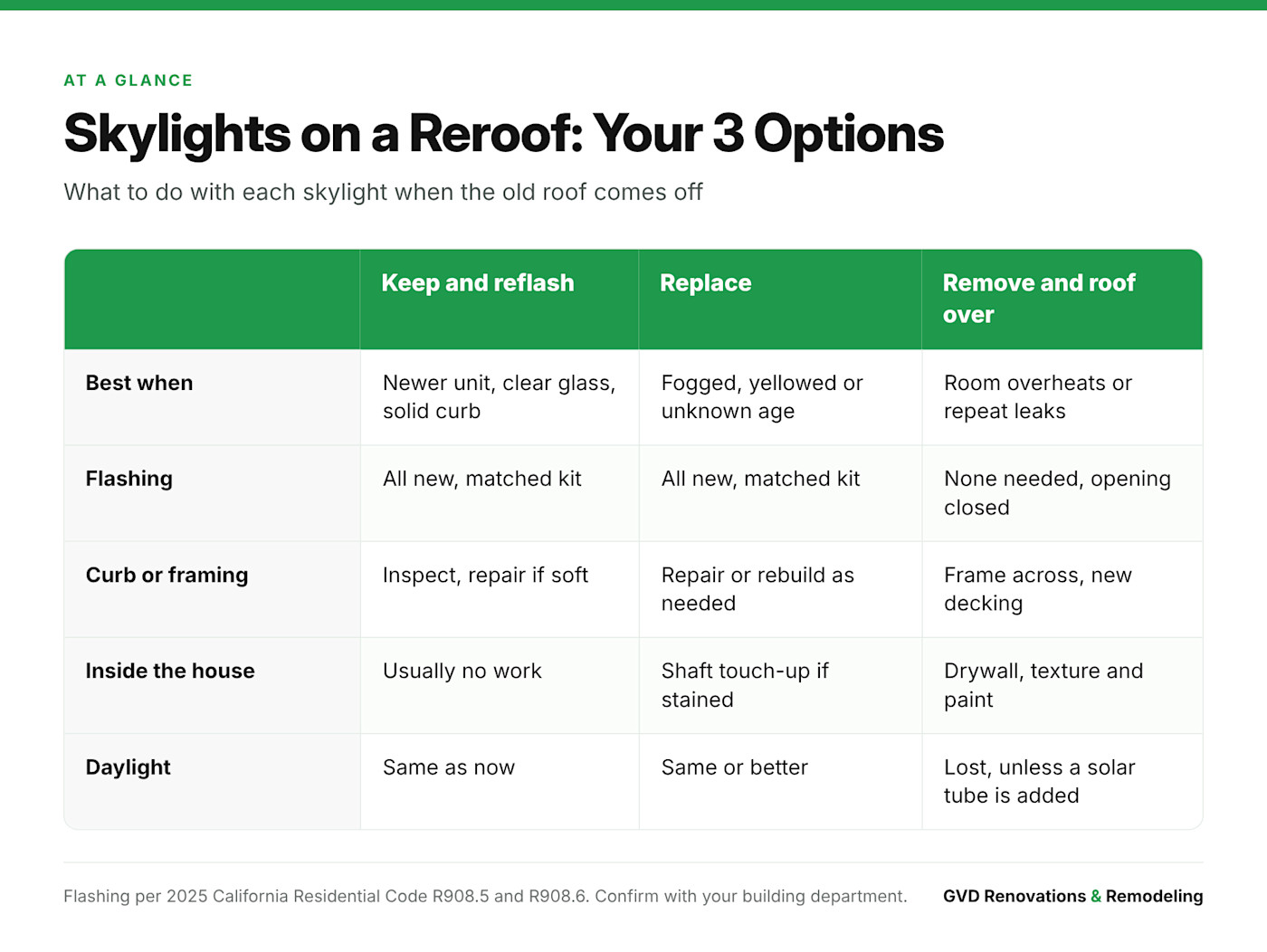
Here is how the three paths usually sort out:
| Option | Makes sense when | What the work includes |
|---|---|---|
| Keep and reflash | The unit is fairly new, the glass is clear, the curb is solid and a matching flashing kit is still sold | New flashing kit, new underlayment around the opening, curb inspection |
| Replace | The glass is fogged, the dome is yellow or crazed, seals are hard, or the age is unknown | New skylight, its matched flashing kit, curb repair or rebuild if needed |
| Remove and roof over | The room overheats, the skylight has leaked repeatedly, or you no longer want it | Framing across the opening, new decking, roofing, and drywall and paint inside |
Deciding which path fits starts with whether the whole roof is due. If you are still weighing that, see our guide to the damage thresholds for repairing vs replacing a roof.
Signs a skylight is near the end
Walk through the house before the roofing estimates and look up at each skylight. These are the signs that point to replacement rather than reflashing:
- Fog or film between the panes. Moisture inside insulated glass means the seal between the panes has failed, and the unit has lost much of its insulating value.
- Yellow, cloudy or crazed acrylic. Plastic domes break down under UV light. Long, hot Sacramento summers speed that up, and a dome that has turned milky is also brittle.
- Hard, cracked or missing seals. Gaskets that crumble when you touch them won't keep out wind-driven rain.
- Soft or stained wood at the curb or light shaft. Wood that gives under finger pressure has rot, and it can't hold a new unit securely.
- No label and no records. Most makers put an ID label inside the frame or sash. If you can't find one and the roof is decades old, plan on replacement.
Leak or condensation?
A stain around the light shaft doesn't always mean the skylight is leaking. Older single-pane or uninsulated units can sweat on cold mornings, and the water runs down the shaft. If the glass is wet on the inside while the weather is dry, it's condensation. If water shows up during storms, water is getting past the flashing or seals. Our guide to water leaking from the ceiling walks through how to trace the source.
Why the flashing is always replaced
Skylight flashing on a shingle roof is a set of metal pieces: a sill or apron at the bottom, step flashing woven into each course of shingles along the sides, and a head piece at the top. Tearing off the old shingles bends and tears those pieces, and old metal rarely lies flat again against new underlayment.
The code covers this. The 2025 California Residential Code, Section R908.5, says existing flashings, edgings and similar parts must be replaced where rusted, damaged or deteriorated, and R908.6 says flashings must be reconstructed to the manufacturer's installation instructions. In practice, a tear-off almost always damages skylight flashing enough that new is the only sound choice.
Manufacturer warranties point the same way. VELUX's installation coverage applies only when its skylights are installed with VELUX flashing, and the company notes that reroofing without re-wrapping the skylight in its adhesive underlayment and flashing voids that coverage. Reusing old step flashing or patching with sealant is not how a skylight is meant to be detailed.
Curb-mounted vs deck-mounted
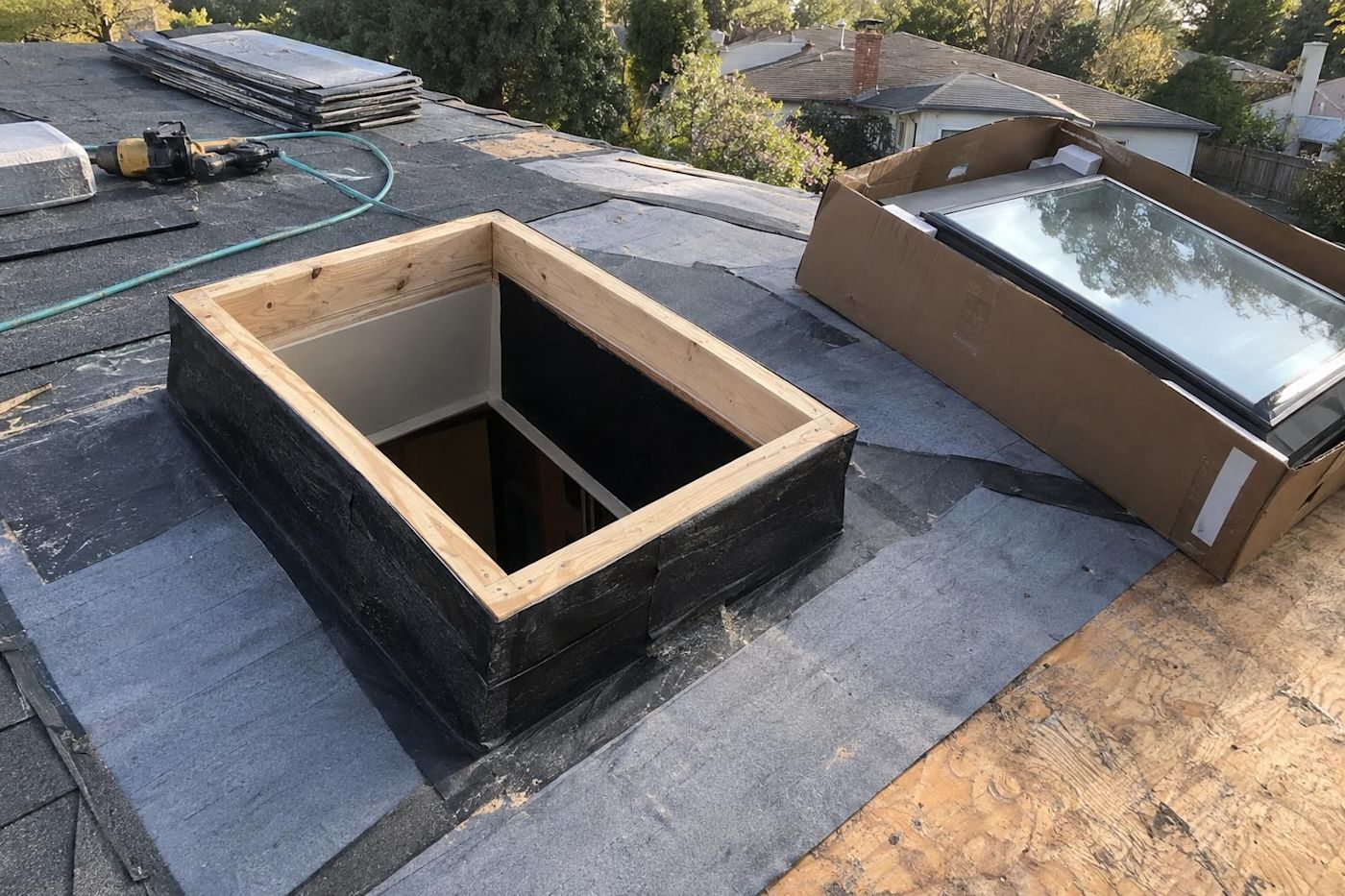
You can tell which type you have from the roof. A curb-mounted skylight sits on a raised wood box built on the deck. A deck-mounted skylight sits lower and fastens directly to the roof sheathing.
Curb-mounted
The skylight attaches to the top of a framed curb. VELUX describes curb-mount units as a good fit for replacing older skylights and for flat or low-slope roofs, because the raised curb helps water drain around the opening. During a reroof, the crew strips the curb to bare wood, checks it for rot, rebuilds it if needed, wraps it in self-adhered underlayment and installs new flashing. If the curb is sound, a replacement unit sized to the existing curb can often go right back on it.
Deck-mounted
A deck-mounted skylight has a frame that fastens directly to the deck and relies on an engineered flashing kit made for that model and roof type, such as kits for asphalt shingle, tile or metal. It has a lower, cleaner profile. VELUX notes that deck-mounted skylights are not suitable for low slopes. On a reroof, the unit and its flashing kit are normally replaced together as a matched set.
Warranties on a new skylight
A new skylight installed during the reroof starts its warranty the same week as your new roof. VELUX markets its deck- and curb-mounted line as the "No Leak Skylight." Its published coverage includes:
- 10 years on installation, which VELUX ties to installation with VELUX flashing
- 10 years on the product
- 20 years on the glass seal (insulated glass), with exclusions for some commercial and large-span units
- 5 years on blinds, controls and solar or electric components
Read the full warranty document for exclusions; condensation, for example, is not counted as a leak. Other brands have their own terms, so ask for the warranty sheet for the exact model in your proposal.
An old skylight left in a new roof can also complicate the roof warranty, because shingle makers generally exclude leaks from penetrations and flashing that weren't installed to their requirements. Ask the roofer to state in writing how a retained skylight affects both the workmanship warranty and the shingle warranty. Our roofing warranty guide explains how those two layers of coverage work.
Removing a skylight or switching to a tube
If a skylight turns a room into an oven every July or has leaked more than once, a reroof is the cleanest time to get rid of it. Outside, the crew frames across the opening, adds new decking and roofs over it like the rest of the deck. Inside, the light shaft is closed off and the ceiling is framed, drywalled, textured and painted. Factor in that interior finish work and the daylight you lose.
A middle path is a tubular daylighting device, often called a solar tube. Products like Solatube use a small rooftop dome and a highly reflective tube to carry daylight into a hallway, bathroom or closet with far less heat than a large skylight, and the roof opening is small and simple to flash. Tubes are easiest to add while the roof is open.
Planning solar panels too? Skylights limit where panels can go, so settle skylight locations before the solar layout. Our guide on replacing your roof before installing solar covers the sequence.
Glass, venting and Title 24
Overhead glass takes direct sun for much of the day, so the glass package matters more than it does on a wall window. Look for an insulated, low-E glass unit with a low Solar Heat Gain Coefficient (SHGC) and a low U-factor, both shown on the NFRC label.
What the energy code requires
California's 2025 Energy Code (Title 24, Part 6), in effect since January 1, 2026, sets limits for replaced skylights on existing homes. Under Exception 2 to Section 150.2(b)1B, a replaced skylight must have a U-factor no greater than 0.40 and an SHGC no greater than 0.30. Elk Grove's 2025 window and skylight alteration form states the same limits. Adding new skylight area is treated differently and can trigger additional requirements, so tell your contractor if you are enlarging or adding skylights. For a plain-language overview of the code, see our California Title 24 guide.
A permit is also required. The City of Sacramento lists both reroofing and skylights among projects that need one, and a skylight replaced in the same opening is normally included on the reroof permit. Our companion post on roof replacement permits in Sacramento covers where to apply and what gets inspected.
Venting and shades
A venting skylight lets hot, humid air out of a bathroom or kitchen. VELUX's Solar Powered Fresh Air skylight uses a small solar panel to charge a battery that runs the motor, with no wiring, and a rain sensor closes it automatically when rain starts. Motors, sensors and remotes add cost and carry a shorter warranty than the glass. On south- or west-facing slopes, a light-filtering or blackout shade cuts afternoon heat in the shaft and the room.
What your estimate should say
A line that says "work around existing skylights" is not enough. Each skylight should be listed separately with one of three decisions: reflash, replace or remove. For each one, the proposal should state:
- Brand, model and size of any new unit, and whether it is fixed or venting
- Glass package, with U-factor and SHGC that meet Title 24
- The flashing kit to be used and confirmation that all flashing is new
- Whether curb repair or rebuild is included, and the price or rate for rot found after tear-off
- Whether interior shaft drywall and paint are included
- That the skylight work is on the permit and included in the inspections
Also ask who installs the skylights. Some roofers subcontract them, which can split responsibility if a leak shows up later. Our list of questions to ask a roofing contractor covers this and more.
Frequently Asked Questions
Can I keep my skylight and just replace the roof around it?
Yes, if the skylight is fairly new, the glass is clear, the curb is solid and a matching flashing kit is available. The flashing should still be new. If the unit is old or its age is unknown, replacing it during the reroof usually costs less over time than tearing back new shingles later.
Can a skylight be replaced without replacing the roof?
Yes. The roofer removes the shingles around the opening, installs the new skylight and flashing, and weaves shingles back in. It takes more labor per skylight than during a reroof, and matching older shingles can be hard.
Does homeowners insurance cover a leaking skylight?
It depends on your policy. Sudden damage, such as a branch breaking the glass, is often covered. Slow leaks from worn seals or old flashing are commonly excluded as wear and tear. Photograph any damage and read your policy before work starts.
How do I find my skylight's size and model?
Look for a label inside the frame or on the sash, which usually lists the maker and model. If there isn't one, measure the outside of the curb or the rough opening, and your contractor can match it to a current size.
Is a solar tube better than a skylight?
For a hallway, bathroom or closet, often yes. A tube brings in daylight with much less heat and a small roof opening. For a large room where you want a view of the sky or ventilation, a skylight does the job better.
Sources
- 2025 California Residential Code, Section R908 (reroofing, reinstallation of materials and flashings)
- California Energy Commission, 2025 Building Energy Efficiency Standards (Title 24, Part 6), Section 150.2(b)1B, via the CEC's Energy Code Ace reference
- City of Elk Grove, Residential Window or Skylight Alteration Energy Form (2025 Energy Code)
- VELUX USA: skylight replacement guidance, mounting and flashing options, No Leak Skylight warranty and Solar Powered Fresh Air skylight product pages
- Solatube: residential tubular daylighting product information
- City of Sacramento Building Division: list of projects that require a permit
Checked November 2026. Warranty terms vary by product and change over time; read the warranty for your exact model, and confirm energy and permit requirements with your building department.
Plan Your Skylights With Your New Roof
GVD Renovations replaces roofs across the Sacramento region and handles the skylights as part of the same job, with each one listed in a written proposal as reflash, replace or remove. See our Sacramento roofing services or visit our Rocklin showroom (6848 Five Star Blvd #6) to talk through options. GVD Renovations Inc. is licensed by the California Contractors State License Board (#989637) and insured.
Reviewed by our team at GVD Renovations, a licensed general contractor. While we strive for accuracy, project specifics vary. Contact us for a personalized assessment. Product details, specifications, or warranties may have changed since publication. Brand and product mentions reflect our professional opinion, not endorsements or guarantees.
Tags: skylights, roof replacement, roof flashing, title 24, sacramento,
Written by Paul Kho


