

Replacing a roof in the Sacramento area takes a building permit, and the first question is which agency issues it. A Sacramento mailing address doesn't tell you; your parcel might be in the City of Sacramento, unincorporated Sacramento County or a separate city like Elk Grove or Citrus Heights. This guide covers when you need a reroof permit, where to apply, what gets inspected, the Title 24 cool roof rule, and how to make sure your roofer handles it properly.
Yes, you need a permit to replace a roof in Sacramento, whether the old roof is torn off or covered with a new layer. The City of Sacramento and Sacramento County both issue residential reroof permits online when there are no structural changes. Expect an inspection of the roof deck nailing before it's covered and a final inspection, and on most steep roofs your new shingles must meet California's cool roof rule for Climate Zone 12 or use an approved alternative.
Do you need a permit?
For a roof replacement, yes. The City of Sacramento lists re-roofing among the projects that require a building permit, along with skylights and repairs. Sacramento County lists "re-roof" the same way. A full tear-off and an overlay (a new layer over the existing one) both count as reroofing.
Small repairs are where people get tripped up. The list of work exempt from a permit in the California Residential Code (Section R105.2) does not include reroofing, and local agencies set their own policies for minor patch repairs. If your roofer says a job is "too small for a permit," ask the building department before work starts rather than taking that on faith.
Structural work changes the permit. Replacing a few damaged sheets of roof sheathing is part of a normal reroof. Changing rafters or trusses, changing the roof pitch or switching to a much heavier material such as tile usually needs plans, and sometimes structural calculations, before the permit is issued. Roseville, for example, asks for stamped plans when roof framing is modified and structural calculations when new tile or steel is installed.
Which office issues it
You apply to the agency that has jurisdiction over your parcel, not the one that matches your mailing address. Many homes with a Sacramento address, including Arden-Arcade, Carmichael and Fair Oaks, are in unincorporated Sacramento County. Your property tax bill or the county assessor's parcel lookup will show which jurisdiction you are in.
| Where the home is | Who issues the permit | How to apply |
|---|---|---|
| City of Sacramento | Community Development Department, Building Division | Online through the city's Public Permit Portal; residential re-roofs are on its online permit list |
| Unincorporated Sacramento County | Building Permits and Inspection Division | Online; a residential re-roof with no structural changes is issued automatically once fees are paid |
| Elk Grove | Building Safety, Inspection and Permits | eTRAKiT portal; re-roofing is on the minor permit list |
| Roseville | Development Services, Building Division | Online permit system; choose home repair, then re-roofing |
| Citrus Heights | Building Division | Permit required before starting; inspections scheduled online or by phone |
| Rancho Cordova | Building and Safety | Rancho Cordova Online portal |
Folsom and the other incorporated cities in the region run their own building departments as well. Portals and forms change, so check your agency's current reroof page before applying.
How the permit process works
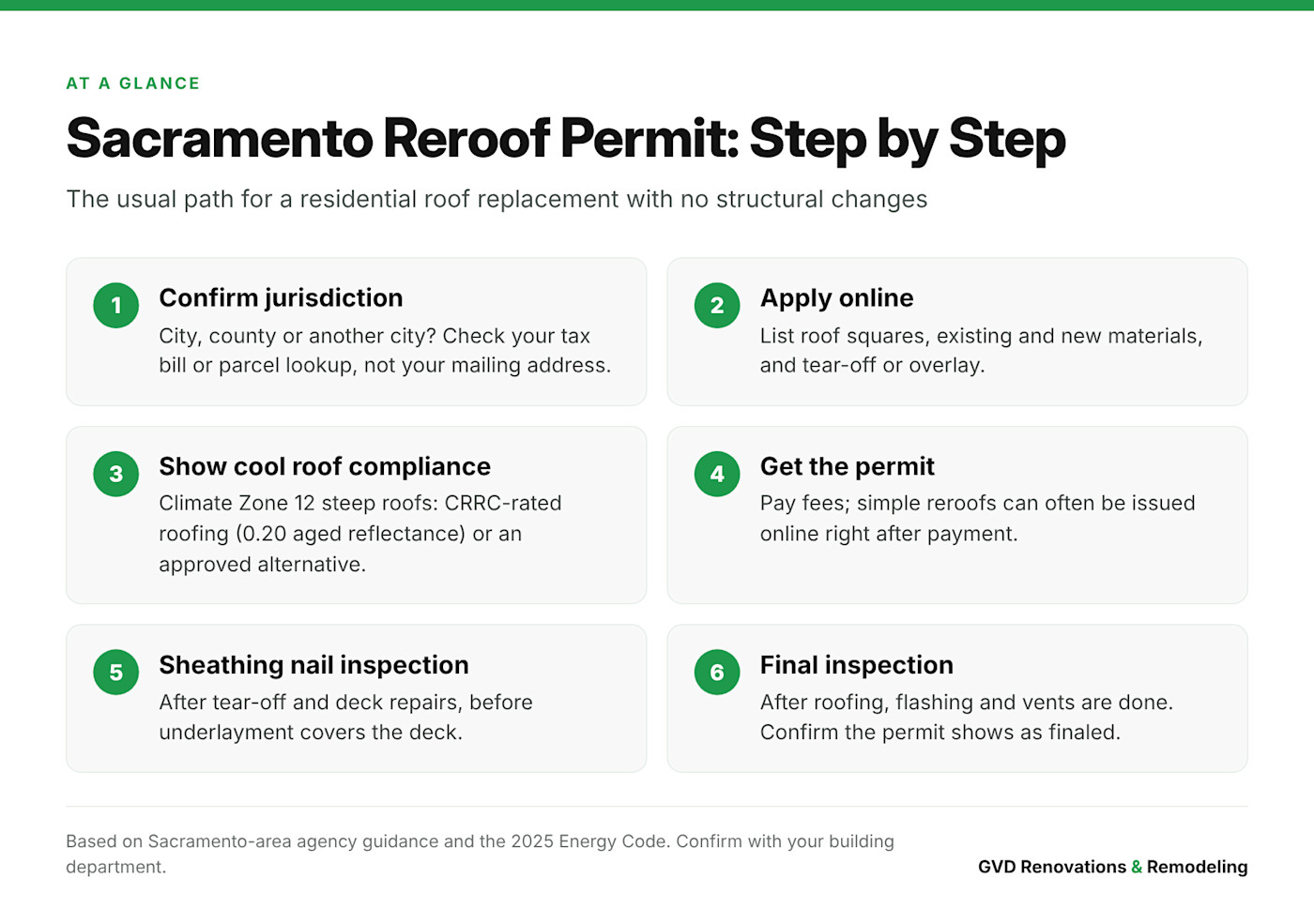
For a standard replacement with no framing changes, the process is short:
- Confirm jurisdiction. Look up the parcel so you file with the right agency.
- Apply online. The application asks for the number of roofing squares (one square is 100 square feet), existing and new materials, and whether the job is a tear-off or overlay. Roseville's checklist asks for exactly these items.
- Submit the energy form. In the City of Sacramento, a reroof application includes a Title 24 certificate of compliance (form CF1R-ALT-05-E) showing the roof meets the cool roof rule or an exception.
- Pay fees and get the permit. Simple reroofs can often be issued online right after payment.
- Pass inspections. Schedule each inspection before the work it covers is hidden.
- Close it out. Make sure the permit shows as finaled in the agency's records.
What it costs
Fees vary by agency and are usually based on project valuation. The City of Sacramento's reroof fee is a building permit fee plus general plan, green building, technology and state strong motion fees, with a city operations tax when a licensed contractor holds the permit. Citrus Heights bases its fee on the roofing contract value. We don't quote fee amounts here because they change; your agency's fee page or your contractor's proposal will show the current total.
What gets inspected
Most Sacramento-area reroofs get two inspections, and some get three:
- Pre-roof inspection (some agencies). Citrus Heights requires one before the job starts. Overlays and some roof types are more likely to need this so the inspector can see what's being covered.
- Sheathing or roof nail inspection. After tear-off and any deck repairs, before underlayment and roofing cover the deck. The inspector checks sheathing nailing and that damaged decking was replaced. Citrus Heights and Rocklin both list a roof nail inspection.
- Final inspection. After roofing, flashing, vents and ridge are complete. In the City of Sacramento, the installer completes the Title 24 installation certificate (CF2R-ALT-05-E) for the inspector at final.
Inspectors need safe roof access. Rocklin, for example, requires a ladder that extends at least three rungs above the roof edge. Your roofer should have it set up before the inspection window.
Title 24 cool roof rules
Sacramento is in California Climate Zone 12. Under the 2025 Energy Code (Title 24, Part 6, Section 150.2(b)1I), in effect since January 1, 2026, the cool roof rule applies to a single-family home when more than 50 percent of the roof is replaced or recovered.
For steep-slope roofs (more than 2:12, which covers most houses), the requirement applies in Climate Zones 4 and 8 through 15, so it applies in Sacramento. The new roofing must have an aged solar reflectance of at least 0.20 and a thermal emittance of at least 0.75, or a Solar Reflectance Index (SRI) of at least 16. Products used to comply must be rated by the Cool Roof Rating Council (CRRC).
You don't have to use a cool-rated shingle if the house meets one of the listed alternatives:
- At least R-38 insulation in the attic (or a ceiling U-factor of 0.025 or lower)
- A qualifying radiant barrier
- No ducts in the attic (an option in Climate Zones 2, 4, 9, 10, 12 and 14)
- R-2 or greater continuous insulation above or below the roof deck
Roofs weighing at least 25 pounds per square foot and areas covered by building-integrated solar panels are exempt. Low-slope roofs (2:12 or less) have a much higher bar: aged solar reflectance of 0.63 and thermal emittance of 0.75, or SRI 75, in Climate Zones 4 and 6 through 15, plus insulation requirements in many zones. For more on the state energy code, see our California Title 24 guide.
Historic homes and design review
In the City of Sacramento, changing roofing material can fall under Site Plan and Design Review. The Planning Division has a roofing exemption form for common changes, such as replacing 3-tab with dimensional composition shingles, but that form can't be used for a historic landmark or a home in a historic district. Those go through the city's preservation review, so start early if your home is listed.
Tear-off or overlay?
The 2025 California Residential Code allows one overlay in limited cases. Section R908.4 does not allow a roof recover when the existing roof is water-soaked or deteriorated, when it is slate, clay, cement or asbestos-cement tile, or when it already has two or more layers. Citrus Heights' reroof policy allows no more than one overlay of composition shingles.
Even where an overlay is legal, a tear-off is usually the better job. It lets the inspector see the deck, lets the crew replace soft sheathing, and gives skylights and other penetrations new flashing. The code requires rusted, damaged or deteriorated flashing to be replaced during a reroof (R908.5). If you have skylights, read our guide on whether to replace a skylight when replacing the roof; a replaced skylight is usually listed on the same permit.
Timing matters too. Inspections and dry-in go smoother outside the rainy season, which our post on the best time to replace a roof in Sacramento covers in detail.
Who should pull the permit
Your roofing contractor should. In California, any job of $1,000 or more in labor and materials requires a contractor licensed by the Contractors State License Board (CSLB); the threshold rose from $500 on January 1, 2025. Roofing is the C-39 classification. According to the CSLB, a General Building (B) contractor taking a roofing-only contract must hold the C-39 license or subcontract the roofing to a C-39 contractor, unless the roof is part of a larger project involving at least two other unrelated trades.
A homeowner can pull a permit as an owner-builder, but the CSLB warns that if you use anyone other than licensed contractors, you may be considered an employer, responsible for workers' compensation, payroll tax withholding and other employer obligations. On a roof, that's a serious risk.
A roofer who asks you to pull the permit yourself is a warning sign; it often means a license, insurance or workers' comp problem. Check any license on the CSLB website. Our lists of roofing contractor red flags and questions to ask a roofing contractor cover what else to check before you sign.
What happens if you skip it
Unpermitted roofing can be stopped mid-job if it's reported or spotted, and agencies typically add an investigation fee on top of the regular permit fee. Getting a permit after the roof is finished is harder, because the inspector can't see the deck nailing or underlayment, and the agency may ask for sections to be opened up.
It also follows the house. California sellers must disclose known alterations or repairs made without required permits on the Transfer Disclosure Statement, and buyers may ask for a credit or a retroactive permit. If an unpermitted roof leaks, expect your insurer to look closely at how it was installed.
Frequently Asked Questions
How do I check if my roofer pulled a permit?
Ask for the permit number before tear-off, then look it up on your agency's online permit portal by number or address. "Issued" means the permit is active; "finaled" means all inspections passed. Don't make the final payment until it shows as finaled.
How long does a reroof permit take?
For a residential reroof with no structural changes, it can be quick. Sacramento County issues these automatically online once fees are paid. Structural changes, a switch to heavy tile or historic review add plan review time.
Do I need a separate permit to remove and reinstall solar panels?
Often, yes. Agencies treat solar and electrical work separately from the roof; Citrus Heights notes that relocating solar, gas or electrical equipment may require additional permits. Our guide to replacing your roof before solar covers planning around panels.
Does the permit cover a new skylight?
A skylight replaced in the same opening is normally included on the reroof permit. The City of Sacramento lists skylights as permit-required work, and Citrus Heights asks applicants to list any added skylights and include their value. Replaced skylights must also meet Title 24 energy limits.
Does a cool roof have to be light colored?
No. Cool-rated composition shingles are made in a range of colors, not just white; what matters is the CRRC-rated aged solar reflectance of the color you pick (0.20 or higher for a steep roof). And if your home qualifies for an alternative, like R-38 attic insulation or no ducts in the attic, you can choose any color.
Sources
- City of Sacramento Building Division: required permits, online minor permits (residential re-roofs), residential re-roof fee components, and form CDD-0304 (re-roof cool roof compliance under the 2025 Energy Code)
- City of Sacramento Planning: roofing exemption from Site Plan and Design Review (CDD-0223)
- Sacramento County Building Permits and Inspection: FAQ on online re-roof permits
- City of Roseville: residential reroof electronic submittal checklist (rev. April 2026)
- City of Elk Grove: plan review and permits page (eTRAKiT minor permits)
- City of Citrus Heights: re-roofing policy CHB1812 (inspections, overlays, fees basis)
- City of Rocklin: residential reroofing requirements (inspections, ladder access)
- City of Rancho Cordova: Building and Safety (online portal)
- California Energy Commission, 2025 Energy Code Section 150.2(b)1I, via Energy Code Ace
- 2025 California Residential Code, Section R908 (reroofing)
- Contractors State License Board: C-39 and B classification rules, AB 2622 minor work threshold, owner-builder responsibilities
Checked November 2026. Permit portals, forms and fees change often; confirm current requirements with your city or county building department before you start.
Get a Permitted Roof Replacement
GVD Renovations replaces roofs across the Sacramento region, and our written proposal states who pulls the permit and what the price includes. Learn more about our Sacramento roofing services or visit our Rocklin showroom (6848 Five Star Blvd #6). GVD Renovations Inc. is licensed by the California Contractors State License Board (#989637) and insured.
Reviewed by our team at GVD Renovations, a licensed general contractor. While we strive for accuracy, project specifics vary. Contact us for a personalized assessment. Product details, specifications, or warranties may have changed since publication. Brand and product mentions reflect our professional opinion, not endorsements or guarantees.
Tags: roof replacement, building permits, cool roof, title 24, sacramento,
Written by Paul Kho


