

Every new or replaced shower valve in California has to protect you from scalding, and there are two main ways to do it: a pressure balance valve or a thermostatic valve. They look similar from the outside, but they work differently, cost differently and suit different showers. This guide explains how each one works, what the 2025 California Plumbing Code requires, how California's flow limits affect multi-head showers, and how to pick the right valve before your walls are opened.
A pressure balance valve is the right choice for most single-showerhead showers and tub-showers: it meets code, costs less and fits a standard wall. A thermostatic valve is worth the upgrade when you want separate temperature and volume controls, several outlets such as a handheld and body sprays, or the tightest temperature control for young children or older adults. Both types are allowed under the 2025 California Plumbing Code, and both must be set so the shower can't deliver water hotter than 120°F.
What California code requires
Section 408.4 of the 2025 California Plumbing Code (CPC), in effect since January 1, 2026, requires every shower and tub-shower combination to have an individual control valve of the pressure balance, thermostatic, or combination pressure balance/thermostatic type. The valve must protect against scalding and thermal shock at the flow rate of the showerhead it serves, and it must be listed to ASSE 1016/ASME A112.1016/CSA B125.16 or ASME A112.18.1/CSA B125.1.
Section 408.4.2 adds a temperature cap: the water coming out of the showerhead must be limited to a maximum of 120°F. On a residential valve, that is done by adjusting the handle limit stop (sometimes called a rotational limit stop) to the manufacturer's instructions. Older code books and some local handouts still show this rule as CPC 408.3; the 2025 edition moved it to 408.4.
In practice, local handouts in the Sacramento region apply the rule whenever the valve is replaced or the tub or shower surround is removed. If you are remodeling a shower that still has an old two-handle valve with separate hot and cold knobs, plan to replace it. Those valves have no pressure or temperature compensation and do not meet the current requirement for new work.
Tip: Ask your installer to set and test the limit stop with a thermometer before the trim plate goes on. It takes a few minutes, it's what the inspector looks for, and it keeps anyone from turning the handle all the way to a scalding temperature.
How each valve works
Pressure balance valves
A pressure balance valve has a spool or diaphragm that sits between the hot and cold supply. When cold water pressure suddenly drops, for example when someone flushes a toilet, the spool shifts and cuts the hot side by a matching amount. The mix stays close to where you set it, and you may notice the flow dip for a moment.
The limitation is that a pressure balance valve reacts to pressure, not temperature. If the hot water itself cools off, such as when a tank water heater starts running low, the valve doesn't add more hot water to make up for it. Most pressure balance valves are single-handle, where one lever turns the water on and sets temperature at a fixed flow. Some models do add a separate volume control: Delta's Monitor 17 Series dual-function cartridge and Moen's M-CORE 4-Series both let you adjust temperature and volume independently while still using pressure balance protection.
Thermostatic valves
A thermostatic valve uses a temperature-sensing element, usually a wax-filled cartridge, that sits in the mixed water. As the outlet water warms, the element expands and shifts the mix toward cold; as it cools, the element contracts and lets in more hot. Because it reads actual temperature, it responds to both pressure changes and changes in the incoming hot water temperature.
Thermostatic valves usually separate the two jobs. One handle sets the temperature, often with a safety button at a set point, and separate volume controls or a built-in volume control turn outlets on and off. You can leave the temperature where you like it and only touch the volume control each day.
How close do they hold temperature?
Both types are tested to the same ASSE 1016 standard, which checks how much the outlet temperature can move when supply pressure changes, and requires the valve to cut flow quickly if the cold supply fails. Thermostatic models generally hold a steadier temperature in everyday use because they react to temperature directly, but a properly listed pressure balance valve is a safe, code-compliant choice. Be wary of marketing that promises exact single-degree accuracy for any valve.
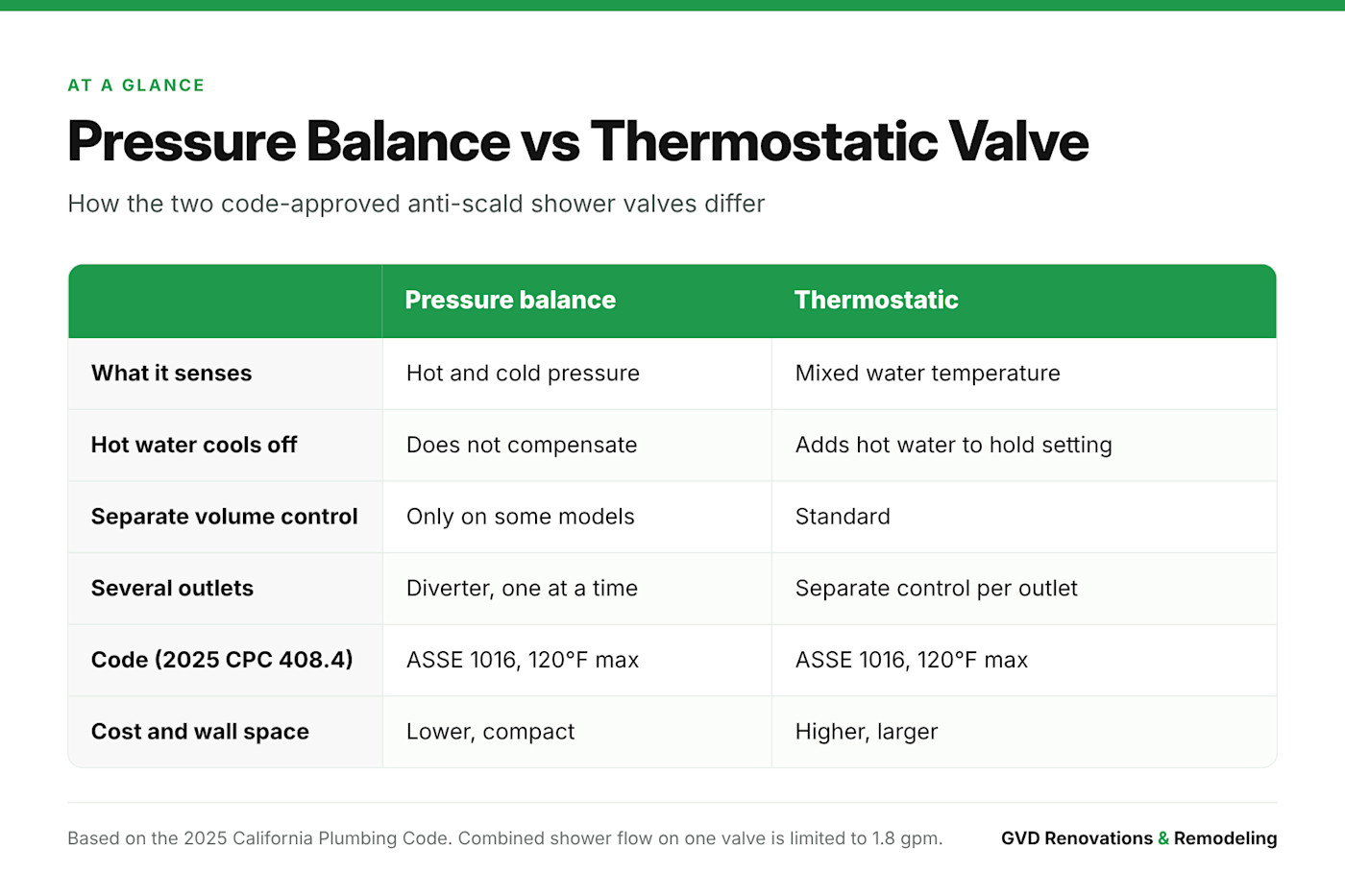
Side-by-side comparison
| Pressure balance | Thermostatic | |
|---|---|---|
| What it senses | Changes in hot and cold pressure | Actual mixed water temperature |
| Hot water cools off | Does not compensate | Adds hot water, as long as supply allows |
| Separate volume control | Only on some models (for example Delta 17 Series, Moen M-CORE 4-Series) | Standard |
| Several outlets | Through a diverter or transfer valve, typically one at a time | Separate volume controls or diverters per outlet |
| Code compliance | Meets CPC 408.4 when listed and limit stop set at 120°F | Same requirements |
| Wall space and cost | Compact; lower cost | Larger valve plus volume controls; higher cost |
Real product lines on each side include Delta's MultiChoice Universal valve (which accepts 13, 14 and 17 Series pressure balance trims and 17T Series thermostatic trims), Kohler's Rite-Temp pressure balancing valves and MasterShower thermostatic valves, and Moen's M-CORE pressure balance system and ExactTemp thermostatic valves.
Multiple heads, body sprays and California flow limits
The usual advice is that multi-outlet showers need a thermostatic valve because pressure balance valves can't pass enough water. That's not accurate. Pressure balance valves are not limited to a trickle: Kohler rates its 3/4-inch HiFlow Rite-Temp valve at up to 13 gallons per minute at 45 psi. The bigger constraints in California are the flow limits.
California caps showerheads at 1.8 gallons per minute at 80 psi under the state's appliance efficiency rules (Title 20) and CPC 408.3.1. The California Green Building Standards Code (CALGreen, Section 4.303.1.3.2) goes further for showers with more than one outlet: the combined flow of all showerheads and other shower outlets controlled by a single valve can't exceed 1.8 gpm, or the shower must be designed so only one outlet runs at a time. Handheld showers count as showerheads, and body sprays are limited too.
What that means for your design:
- A rain head plus a handheld is common and works with either valve type, usually with a diverter or transfer valve so one runs at a time, or with outlets chosen so the combined flow stays within the limit.
- A full body-spray tower running all outlets at once at high volume is not something a California shower can be designed to do on one valve. Ask your designer how the layout meets CALGreen before you buy fixtures.
- Where you do want separate controls for each outlet, a thermostatic valve with volume controls is the cleaner setup: temperature stays set and each outlet has its own on/off and volume.
Inspectors check fixture flow ratings, so choose showerheads, handhelds and body sprays that are certified for sale in California.
Tankless water heaters
Both valve types work with a modern tankless water heater. The thing to watch is very low flow: a tankless unit needs a minimum flow of hot water to stay lit, and a low-flow showerhead set to a mostly cold mix draws only a small amount of hot water. If you've had cold bursts with a tankless heater, have your plumber check the heater's minimum activation flow and the valve setting. A thermostatic valve can smooth out small temperature swings from the heater, but it can't fix a heater that keeps shutting off.
What drives the installed cost
A pressure balance valve is the lower-cost choice. It's a single, compact valve body with hot and cold inlets and one or two outlets, and it fits in a standard 2x4 stud wall.
A thermostatic setup costs more for three reasons:
- Parts: the thermostatic valve and trim cost more, and multi-outlet showers add volume control valves or diverters.
- Rough-in labor: each extra outlet adds supply lines, fittings and time.
- Wall space: larger valves and several controls may need extra blocking, a wider layout or rerouted piping.
The price gap matters most on a small hall bath with one showerhead, where a thermostatic valve rarely pays off. On a primary bath with a rain head and handheld, it is a small share of the total. For full-project numbers, see our Sacramento shower remodel cost guide.
Whichever valve you choose, it should be roughed in before backer board and waterproofing go up, and the waterproofing has to be sealed around the valve body. Our guide to shower waterproofing methods covers how that penetration is sealed so it doesn't leak.
Cartridges, water quality and upkeep
Both valve types have a replaceable cartridge, and minerals in your water are the main thing that wears it out. Water hardness varies across the Sacramento region depending on whether your supplier draws from rivers or groundwater, so check your water provider's annual water quality report if you want to know your number.
Signs a cartridge needs attention:
- Stiff or gritty handle: scale is building up on moving parts.
- Drips after shutoff: seals are no longer seating.
- Temperature wanders or won't get hot: the spool or thermostatic element is sticking, or the limit stop needs resetting.
Replacing a cartridge does not require opening tile. With the water off, the handle and trim come off, the retaining clip or nut is removed, and the new cartridge slides in. After any cartridge change, the limit stop has to be checked again so the outlet temperature stays at or below 120°F. Thermostatic cartridges have tighter tolerances, and some include small inlet screens that need occasional cleaning.
Tip: Use the manufacturer's replacement cartridge and keep the model number with your house records. If the brand is worn off the trim, the cartridge itself usually identifies the valve.
How to choose
Choose a pressure balance valve if:
- The shower has one showerhead, or a tub spout and showerhead.
- It's a hall, guest or kids' bath where simple operation matters most.
- You want to keep the budget for tile, glass or storage instead.
Choose a thermostatic valve if:
- You want to set temperature once and use a separate control to turn the water on and off.
- You're planning a rain head with a handheld or body sprays and want separate controls for each.
- Someone in the house is especially sensitive to temperature, such as a young child or an older adult. Our walk-in showers for seniors guide covers other safety features to plan at the same time.
Whichever you choose, pick the valve and trim before demolition. The rough-in depth, outlet count and control locations all have to be set before the wall is closed, and a valve can't be upgraded later without opening it unless the rough-in was built for it.
Frequently Asked Questions
How can I tell which shower valve I have?
Look at the controls. A single handle that turns from cold to hot with no separate volume knob is almost always a pressure balance valve. A temperature dial with its own volume control or separate outlet controls is usually thermostatic, though some pressure balance models also have separate volume. Two separate hot and cold handles usually mean an older valve without anti-scald protection.
Can I switch to a thermostatic valve without opening the wall?
Usually not, because pressure balance and thermostatic valve bodies are different. The main exception is Delta's MultiChoice Universal rough-in, which Delta says accepts its 13, 14, 17 and 17T Series trims, so you can move to a 17T thermostatic trim without replacing the valve body. Check the brand and model in your wall before assuming this applies.
Is a pressure balance valve safe for kids and older adults?
Yes, when it's listed to ASSE 1016 and the limit stop is set so the water can't exceed 120°F. A thermostatic valve holds temperature more steadily, which some families prefer, but both meet the same safety standard.
Can I have two showerheads in California?
Yes, but the combined flow of all outlets on one valve can't exceed 1.8 gpm, or the shower has to be set up so only one outlet runs at a time. Most two-head showers use a diverter for that reason.
How long does a shower valve replacement take?
Replacing a valve with good access, such as from a closet behind the shower, is often a few hours of plumbing work. If tile has to be opened and repaired, it becomes a small remodel. In a full remodel, the valve is roughed in early and the trim goes on after tile and grout are finished.
Sources
- 2025 California Plumbing Code, Sections 408.3 (showerhead flow), 408.4 and 408.4.2 (individual shower control valves and 120°F maximum)
- 2025 California Green Building Standards Code (CALGreen), Section 4.303.1.3.2: multiple showerheads serving one shower
- California Energy Commission, Title 20 appliance efficiency regulations: 1.8 gpm showerhead limit
- City of Roseville and City of Sacramento 2025-code residential bathroom remodel handouts
- ASSE 1016/ASME A112.1016/CSA B125.16: performance requirements for individual shower control valves
- Manufacturer product pages and specification sheets: Delta MultiChoice Universal valve, Kohler Rite-Temp K-2971 and MasterShower K-2976, Moen M-CORE and ExactTemp
Checked November 2026. Product lines and local enforcement change; confirm fixture choices and requirements with your building department and the manufacturer.
Plan Your Shower Valve With GVD
GVD Renovations helps Sacramento-area homeowners choose the right valve, trim and outlet layout as part of a full shower remodel, and sets the rough-in before tile goes up. See our shower replacement services or bathroom remodeling, try the bathroom cost calculator, or compare valve trims with a designer at our Rocklin showroom (6848 Five Star Blvd #6). GVD Renovations Inc. is licensed by the California Contractors State License Board (#989637) and insured.
Reviewed by our team at GVD Renovations, a licensed general contractor. While we strive for accuracy, project specifics vary. Contact us for a personalized assessment. Product details, specifications, or warranties may have changed since publication. Brand and product mentions reflect our professional opinion, not endorsements or guarantees.
Tags: pressure balance valve, thermostatic shower valve, shower valve, anti-scald valve, shower remodel, sacramento,
Written by Paul Kho


