

Old wood windows are a big part of what makes a Sacramento Victorian or Craftsman look the way it does, and they are also drafty, hard to open and hot in summer. If your home is a city landmark or sits in a historic district, you cannot simply order new windows and swap them out. This guide explains how preservation review works in the City of Sacramento, when repair is expected over replacement, and what the energy, building and lead-safety rules require.
If your home is a Sacramento landmark or a contributing building in a historic district, replacing original windows needs approval from the city's Historic Preservation staff before you get a building permit. The city reviews under the Secretary of the Interior's Standards, which favor repair, and it asks for a condition report before it will consider replacement. Approved replacements must match the originals in material, design, dimensions and profile, and the city's design standards say to avoid vinyl windows and false divided lites.
Check whether your home is historic
Start with status, because it decides everything else. The Sacramento Register lists nearly 900 landmarks and more than 30 historic districts, including Boulevard Park, Alkali Flat, Newton Booth and Poverty Ridge. You can look up an address in the city's Planning Land Use Information portal, linked from the city's Historic Preservation page.
Inside a district, each building is classed as a landmark, a contributing resource or a non-contributing resource. The rules differ:
- Landmark or contributing: replacing original windows requires a preservation application.
- Non-contributing: replacement can be exempt from full review if the new windows match the material and type on the rest of the building and the openings, trim and sills do not change.
- Not listed at all: no preservation review, but the normal building permit and energy rules still apply. The city does recommend checking with staff before altering buildings over 50 years old, since some may be eligible for listing.
Homes outside the City of Sacramento, in the county or other cities, follow their own local preservation rules, so check with that jurisdiction.
How Sacramento preservation review works
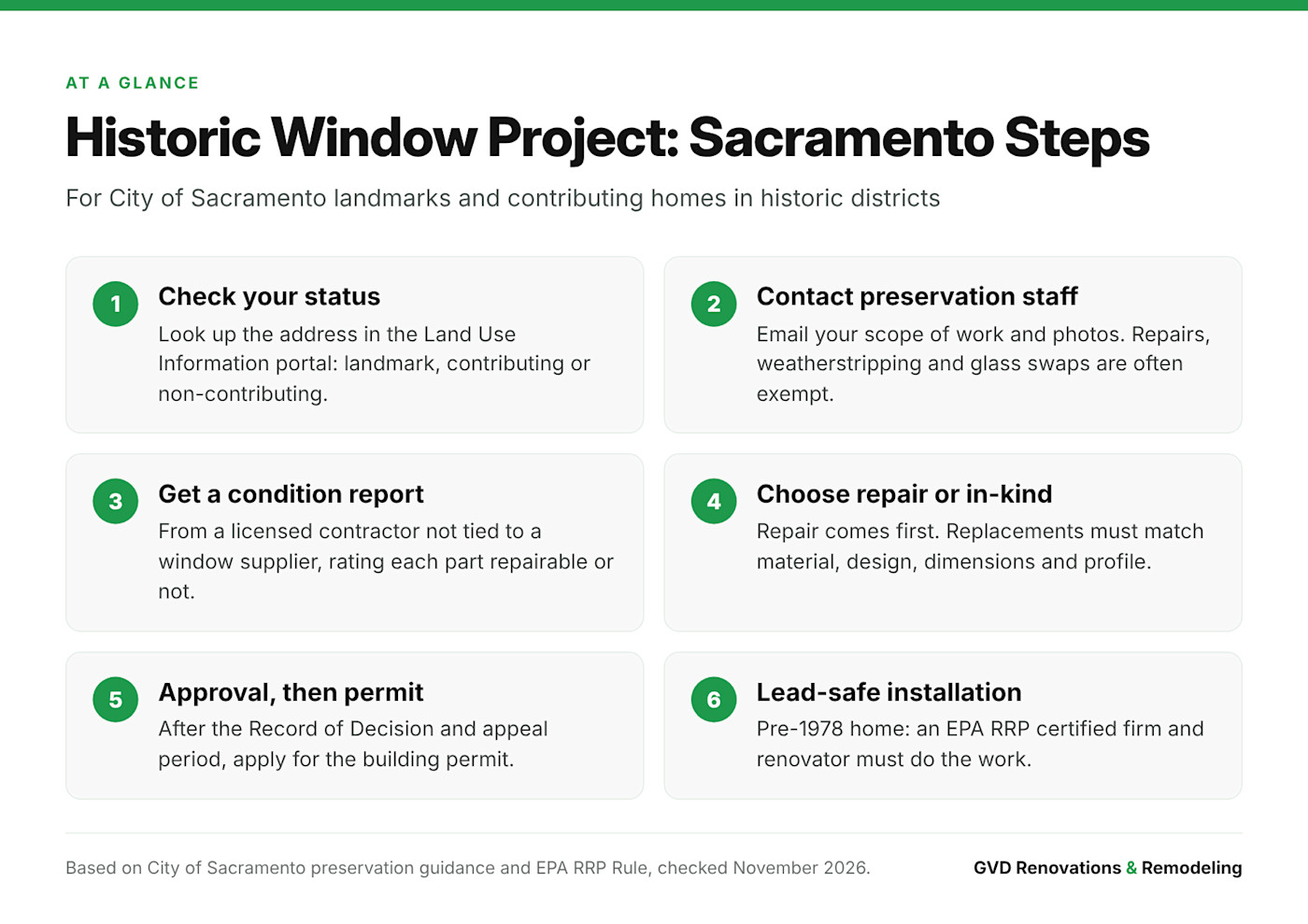
The city's Historic Preservation staff review exterior changes, and windows, siding, roofs and additions are all on the list. Interiors of private homes are generally not reviewed. The city lays out the process in steps:
- Confirm the property's status in the Land Use Information portal.
- Email a clear scope of work and photos to the planning department so staff can route the project. Some window work is exempt and needs no application.
- Request a preliminary review. Staff may suggest a pre-application meeting.
- Submit the application and fees online. Staff review it against the City Code, the Secretary of the Interior's Standards and any district plan. Some projects go to a hearing before the Preservation Director or the Preservation Commission.
- Once staff issue a Record of Decision and Conditions of Approval and the appeal period ends, apply for the building permit.
Any change after approval, such as switching window brands, has to be cleared with Preservation staff first. The city does not publish a set review time, so build review into your schedule before ordering anything.
Work that is usually exempt
The city's window and door exemption form lists work on landmark and contributing buildings that staff can approve without a full application, as long as trim and sills stay the same and openings are not resized:
- Repairing sashes and replacing missing cords, weights, hinges or matching hardware
- Caulking, weatherstripping, patching and repainting
- Replacing clear glass in original sashes, including dual-pane glass if the sash is wide enough
- Adding clear insulating film or an interior storm window
- Replacing missing or non-original windows with units that match the historic originals in kind
Repair first: what the city expects
Sacramento's preservation guidance follows Standard 6 of the Secretary of the Interior's Standards: deteriorated historic features are repaired rather than replaced. The city's district design standards say the same thing, and suggest weatherstripping or glazing film rather than swapping single-pane windows for double-pane units.
Staff will consider replacing a component when more than 50% of it is too deteriorated to repair, and they apply the same 50% guideline to a whole window. Even then, sound original parts should be reused where possible, and some components may need repair even past that threshold.
To make the case for replacement, the city asks for a written condition report from a licensed contractor who is not affiliated with a replacement window supplier. The report locates each window on a key plan and rates each part, such as sash, sill, rails and muntins, as repairable or not. The National Park Service's Preservation Brief on repairing historic wooden windows is the reference for repair methods.
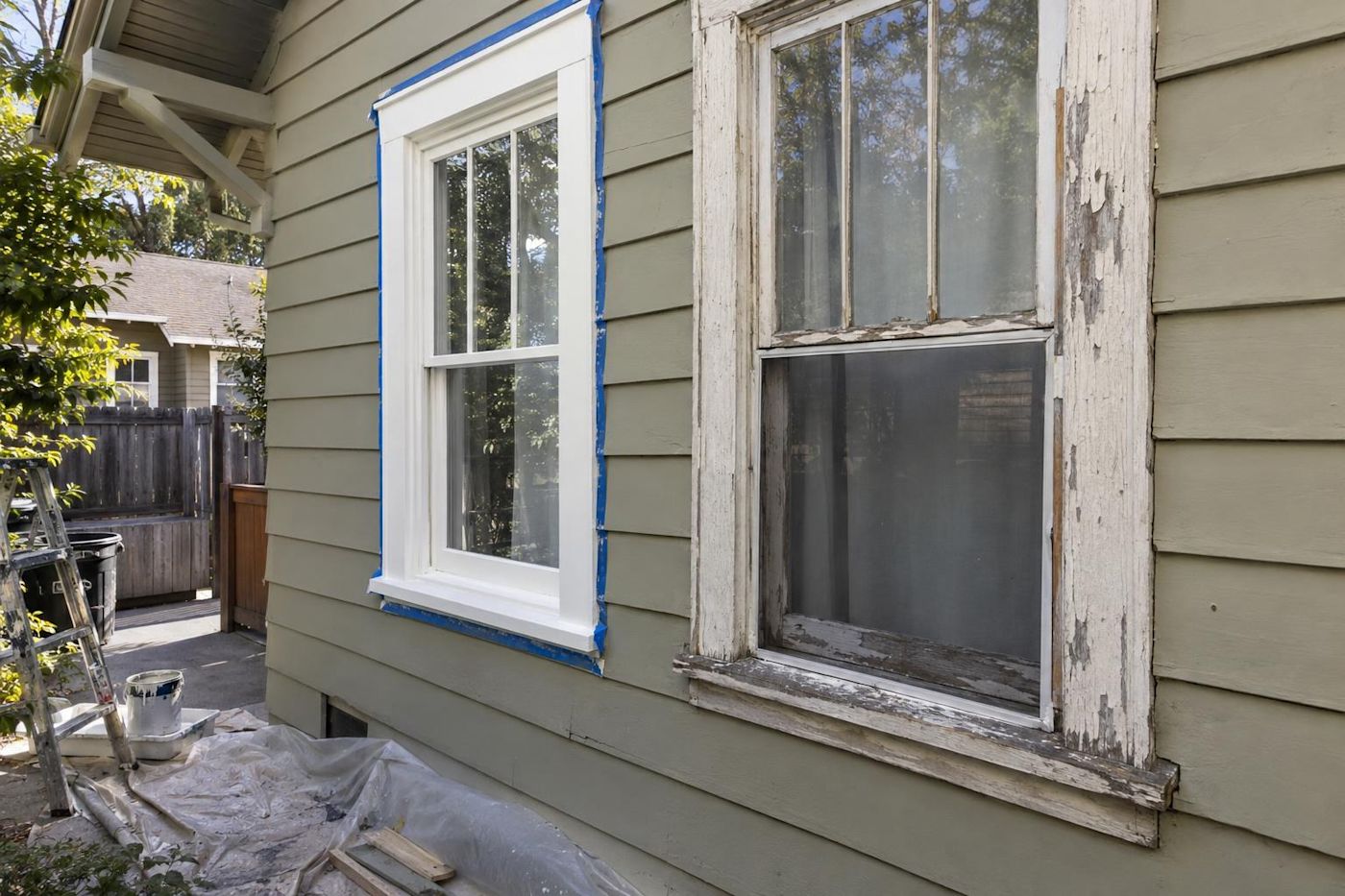
Peeling paint, broken sash cords and cracked glass are maintenance, not grounds for replacement. A rotted sill can often be repaired too; see our guide to fixing a rotted window sill.
When replacement is allowed and what must match
When replacement is approved, the city's standard is "in-kind": matching the historic materials, design, dimensions, profile, placement and finishes. Staff may allow small changes in dimensions or profile to fit dual- or triple-pane glass. If the original material is no longer available, a substitute that achieves the same look may be considered.
In practice, that means paying attention to:
- Window type. Most older Sacramento homes have double-hung windows. The exemption form allows single-hung sashes in matching replacements.
- Sash and frame size. Narrow wood stiles and rails, wide bottom rails and a real sill.
- Setback. Where the glass sits in the wall, which creates the shadow line you see from the street.
- Grille pattern. Two-over-two on many Victorians, multi-pane uppers on many Craftsman homes.
The city's design standards for all districts say to avoid vinyl windows and false divided lites, and they call vinyl windows with false divided lights incompatible with wood-framed contributing buildings. Wood or clad-wood windows with true or permanently applied divided lites are the usual path, but ask staff what they will accept before you order. Our comparison of window frame materials explains the differences.
A building permit is still needed for the replacement itself. Our guide to window replacement permits covers what the building department looks at, including bedroom egress.
Energy code and historic windows
California's Energy Code (Title 24, Part 6) normally sets limits on replacement windows. Under the 2025 code, in effect since January 1, 2026, a home in Climate Zone 12, which covers Sacramento, prescriptively needs replacement windows with a U-factor of 0.27 or lower and a solar heat gain coefficient (SHGC) of 0.23 or lower. A smaller job replacing 75 square feet of windows or less can use a U-factor of 0.40 and SHGC of 0.35. Our Title 24 guide has more background.
Qualified historic buildings are treated differently. Section 100.0(a) of the Energy Code exempts qualified historic buildings regulated by the California Historical Building Code (Title 24, Part 8) from the Energy Code, except for certain lighting rules. The Historical Building Code applies to buildings deemed significant by a local, state or federal government, including those on city and county registers. Your building official decides whether it applies to your home, so raise it early.
If you keep your original windows, there are still ways to cut heat gain: tight weatherstripping, interior storm windows and clear films that lower heat radiation, all of which the city's guidance supports.
Lead paint and pre-1978 homes
Almost every historic Sacramento home has lead paint somewhere, and old window sashes and sills are among the worst spots. The EPA's Renovation, Repair and Painting (RRP) Rule applies to work that disturbs paint in homes built before 1978.
- The contractor firm must be EPA or state certified, and the work must be done or directed by a certified renovator using lead-safe practices.
- Before work starts, the firm must give you EPA's lead pamphlet.
- The usual small-job exemption (6 square feet or less inside per room, 20 square feet or less outside) does not apply to window replacement, so window replacement is always covered.
- A certified renovator must do cleaning verification before the area is re-occupied.
Ask for the firm's certification and the renovator's certificate before you sign.
Your options compared
| Option | Typical review path | What you get | Best when |
|---|---|---|---|
| Repair and weatherstrip originals | Usually exempt | Original look; smoother operation, fewer drafts | Sashes are mostly sound |
| Insulated glass in original sashes | Exempt if sash is wide enough | Original frames with dual-pane glass | Sashes are sound and deep enough |
| Interior storm windows | Exempt | Second pane, no exterior change | You want comfort without touching the sash |
| In-kind wood or clad-wood replacement | Preservation application | New units matching original profile | Condition report shows most parts beyond repair |
| Vinyl replacement | Avoided on historic buildings | Lower cost, no painting | Home is not designated |
Mills Act and incentives
The Mills Act is California's main tax incentive for historic homes. In Sacramento, landmarks and contributing resources in historic districts can apply for a contract with the city. The owner agrees to maintain and invest in the property under a 10-year workplan, and the property is assessed in a way that usually, but not always, lowers property taxes. Contracts renew each year and stay with the property when it sells.
Applications are due by July 1 each year, and City Council approves or denies them. The city lists an application fee of $4,603 for buildings of 2,500 square feet or less and $8,416 for larger buildings, plus a technology surcharge, so check the current fee before applying. Window repair can be part of the workplan.
Don't plan on a federal tax credit for windows. The Energy Efficient Home Improvement Credit ended for property placed in service after December 31, 2025.
Frequently Asked Questions
Can I put vinyl windows in a historic Sacramento home?
Not on a landmark or contributing building in most cases. The city's district design standards say to avoid vinyl windows and false divided lites. On a non-designated older home, vinyl is allowed.
Do I need approval just to repair my old windows?
Usually not. Repairs, weatherstripping, repainting, new sash cords and replacing glass in original sashes are on the city's exemption list, as long as trim, sills and opening sizes stay the same.
Can I add double-pane glass to my original sashes?
Often, yes. The city lists replacing clear glass in original sashes, including dual-pane glass, as exempt work if the sash is wide enough to hold it.
Who decides whether my windows can be replaced?
Sacramento's Historic Preservation staff, based on a condition report from a licensed contractor not tied to a window supplier. Some projects go to the Preservation Director or the Preservation Commission.
Do historic homes have to meet Title 24 energy rules for windows?
Qualified historic buildings under the California Historical Building Code are exempt from the Energy Code except for some lighting rules. Your building official confirms whether your home qualifies.
Sources
- City of Sacramento Historic Preservation: program page, Preservation Step by Step, and Mills Act Program page
- City of Sacramento forms CDD-0033 (window and door exemptions), CDD-0080 and CDD-0082 (window condition reports and treatment)
- City of Sacramento Design Standards for All Historic Districts (windows, vinyl, divided lites)
- California Energy Commission: 2025 Energy Code Section 100.0(a) and 2025 single-family alteration form CF1R-ALT-05-E (replacement window limits)
- California Historical Building Code (Title 24, Part 8) and Health and Safety Code 18955 (qualified historical buildings)
- U.S. EPA: RRP Rule and 2026 Small Entity Compliance Guide
- National Park Service Preservation Brief 9: The Repair of Historic Wooden Windows
Checked November 2026. City procedures, fees and code limits change; confirm with Sacramento Historic Preservation staff and your building department before ordering windows.
Plan Your Historic Window Project With GVD
GVD Renovations installs replacement windows across the Sacramento region, including wood and clad-wood windows from Andersen, where we are an Andersen Certified Contractor. If your original sashes can be saved, a sash restoration specialist is the better hire, and we will tell you so. When replacement is the right call, we measure each opening, plan around review and custom lead times of about 10 to 12 weeks, and give you a written quote. GVD Renovations Inc. is licensed by the California Contractors State License Board (#989637) and insured. Learn more about Andersen windows or visit our Rocklin showroom (6848 Five Star Blvd #6).
Reviewed by our team at GVD Renovations, a licensed general contractor. While we strive for accuracy, project specifics vary. Contact us for a personalized assessment. Product details, specifications, or warranties may have changed since publication. Brand and product mentions reflect our professional opinion, not endorsements or guarantees.
Tags: windows, historic homes, window replacement, historic preservation, sacramento,
Written by Paul Kho


