

Tile and grout make a shower look finished, but they don't keep water out of your walls. The layer that does is the waterproofing behind and under the tile, and when a tiled shower leaks into framing or a ceiling below, that layer is almost always where it failed. This guide explains what California code requires, how the three main waterproofing methods work, where showers usually leak, and how a flood test proves the work before tile covers it.
A tile shower needs a continuous waterproof layer under the floor and up the walls: either a traditional liner (PVC, CPE or hot mop) under a sloped mortar bed, a bonded sheet membrane such as Schluter KERDI, or a liquid-applied membrane such as RedGard or Hydro Ban. Sheet and liquid membranes should meet ANSI A118.10, and every system must be installed to the manufacturer's instructions. The shower pan should pass a flood test before any tile goes down.
Why tile and grout aren't waterproof
Most shower tile is dense, but cement grout is porous. It absorbs water every time the shower runs, and hairline cracks or failed caulk at corners let more water through. Epoxy grout absorbs far less, but it still doesn't replace a membrane, because joints, corners and the tile edges can still move and open up over time.
When there's no continuous barrier behind the tile, that water reaches studs, drywall and subfloor. Signs that water is already getting behind tile include:
- Grout or tile that stays dark long after the shower is used
- Hollow-sounding or loose tiles
- A soft floor or lifting flooring just outside the curb
- Mildew along the bottom joints that comes back quickly after cleaning
- Stains or peeling paint on a ceiling below the bathroom (see our guide to water leaking from a ceiling)
What California code requires
California adopted the 2025 California Building Standards Code on January 1, 2026. Three sections matter most for a tiled shower.
Shower pan liners (CPC 408.8)
For a shower floor built on site, the 2025 California Plumbing Code (CPC) Section 408.8 requires the subfloor and rough walls to be lined with a watertight material to at least 3 inches above the top of the finished dam or threshold. The liner must turn up the rough jambs of the opening, extend over the threshold and be fastened on the outside face. Built-in seats get the same 3-inch turn-up above the seat.
The liner must be pitched 1/4 inch per foot to the weep holes of the drain, over a smooth, solidly formed base (the pre-slope). It can't be nailed or punctured lower than 1 inch above the finished threshold. Approved materials include PVC sheet (ASTM D4551), chlorinated polyethylene or CPE sheet (ASTM D4068), sheet lead or copper, and a hot-mopped built-up pan of at least three layers of 15-pound asphalt felt.
The pan test (CPC 408.8.5)
Shower receptors must be tested for watertightness by filling them with water to the level of the rough threshold, at least 2 inches deep, with the test plug placed so both sides of the liner are tested where it clamps to the drain.
Wall surfaces (CRC R327.2)
The 2025 California Residential Code requires shower walls to have a smooth, nonabsorbent surface to at least 6 feet above the floor. The City of Sacramento's bathroom remodel handout adds that the backing must be cementitious or an approved gypsum board, and that "greenboard" is not acceptable.
Membrane makers often go further: Schluter calls for its wall membrane to run at least to showerhead height.
The three waterproofing methods
1. Mortar bed with a liner or hot mop
This is the traditional method. A sloped mortar pre-slope goes down first, then the liner, then a thick sand-and-cement mortar bed on top. The drain has two parts: a lower body that clamps the liner, with weep holes, and an adjustable upper strainer at tile level. Water that soaks through the tile and mortar runs down the liner to the weep holes.
Hot mop is the California variation: a built-up pan of asphalt felt and hot asphalt applied over the pre-slope. It's still widely bid in California and is listed in the CPC.
The trade-off is that the mortar bed above the liner holds water after each shower and dries slowly. If the weep holes clog with mortar, water sits in the bed even longer, which can lead to odors, efflorescence and darkened grout. Protecting the weep holes, as the code requires, matters.
2. Bonded sheet membranes
Schluter KERDI is the best-known example: a thin polyethylene sheet (8 mil, per its ICC-ES evaluation report) with fleece on both sides that is embedded in thin-set mortar over the wall backing and a sloped base. The waterproofing sits right behind the tile, so the bed under the tile stays mostly dry.
The sheet's thickness is uniform; the work is in the details. Schluter's shower handbook calls for:
- Seams overlapped at least 2 inches, or butted and covered with KERDI-BAND
- Preformed inside and outside corners at every corner
- The sheet bonded with Schluter's own setting mortars or an unmodified thin-set meeting ANSI A118.1
- A mortar bed or foam tray sloped 1/4 inch per foot to a bonding-flange drain
Foam boards such as KERDI-BOARD can replace the backer board on walls, with seams and fasteners sealed. Schluter recommends waiting at least 24 hours after the membrane is finished before water testing, so the thin-set under it can set.
3. Liquid-applied membranes
Liquid membranes are rolled or brushed onto backer board and the sloped base and cure into a continuous rubbery layer. Because the installer creates the thickness, the number of coats and the drying time between them matter more than the brand.
RedGard (Custom Building Products) goes on pink and dries to a dark red. Its data sheet requires at least two coats when applied by roller or brush, lists a cured thickness of 0.015 to 0.038 inch (15 to 38 mils), and gives a typical dry time of 1 to 1.5 hours per coat, longer in cold or humid conditions. It is listed with IAPMO as a shower pan liner and meets ANSI A118.10. The data sheet limits regular drywall to dry interior areas, so it isn't a shower wall substrate.
Hydro Ban (LATICRETE) goes on light sage and turns olive green when cured. It requires two coats for a dried thickness of 20 to 30 mils, and LATICRETE says it does not need fabric in the field, coves or corners (gaps over 1/8 inch need treatment first). Its data sheet allows flood testing 2 hours after final cure at 70°F or warmer, or 24 hours at 50 to 69°F. It lists gypsum wallboard for interior non-wet areas only, and asks for local building authority approval before use in shower pans.
The mortar that sets the tile
Tile is set over the membrane with a thin-set mortar the membrane maker approves. The common standards are ANSI A118.1 (unmodified dry-set mortar), A118.4 (modified dry-set mortar) and A118.15 (improved modified dry-set mortar). Using the wrong one can void the membrane warranty, so it's worth asking which one your installer plans to use.
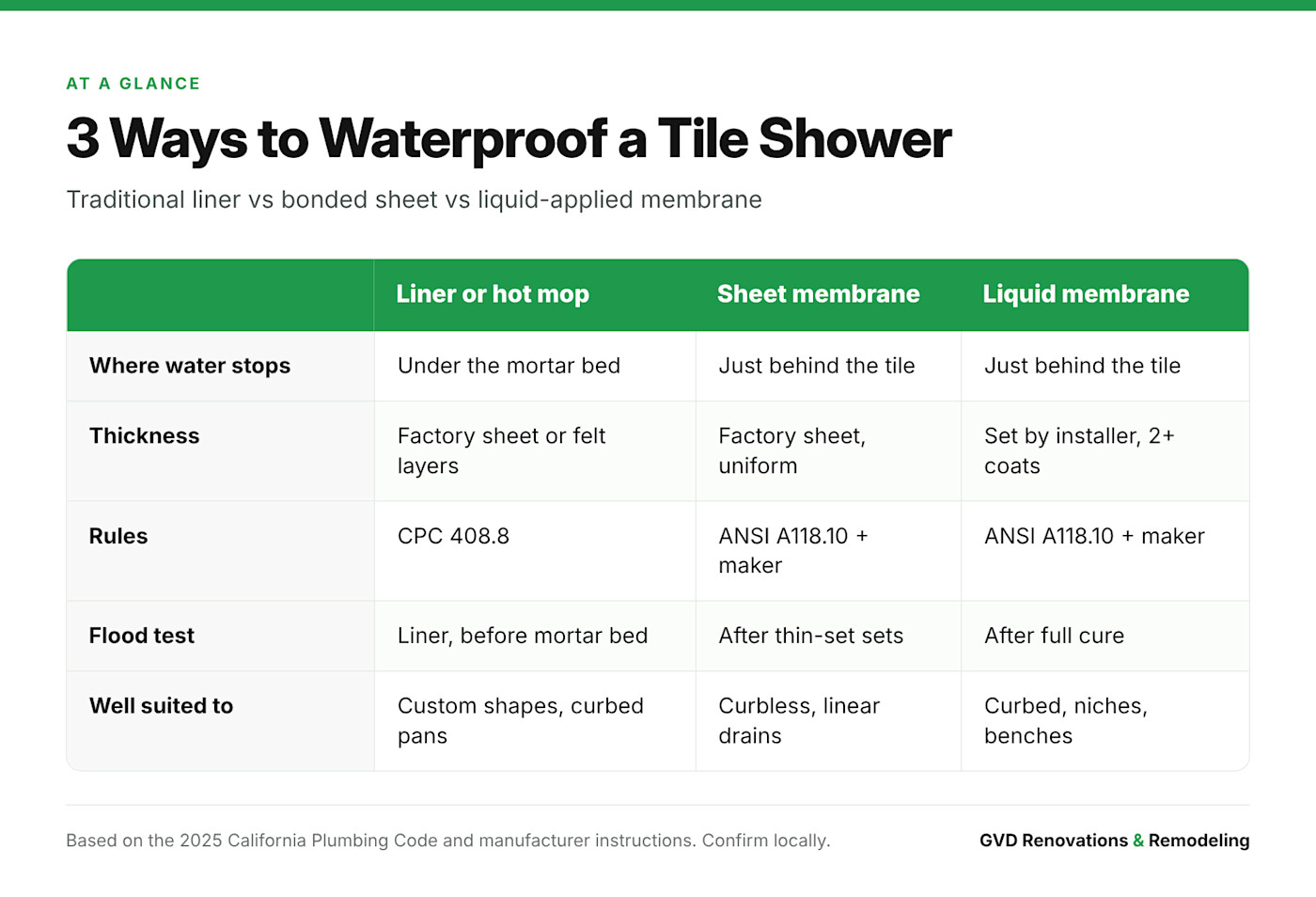
Methods compared
| Liner or hot mop | Sheet membrane | Liquid membrane | |
|---|---|---|---|
| Where water stops | At the liner, under the mortar bed | Just behind the tile | Just behind the tile |
| Thickness control | Factory sheet or built-up felt layers | Factory sheet, uniform | Set by the installer; two coats minimum |
| Governing rules | CPC 408.8 | ANSI A118.10 plus manufacturer instructions | ANSI A118.10 plus manufacturer instructions |
| When to flood test | Liner, before the top mortar bed | After the thin-set sets (Schluter: 24 hours) | After full cure per data sheet |
| Well suited to | Custom shapes, traditional curbed pans | Curbless showers, linear drains, steam | Curbed showers, niches, benches |
Where tile showers usually leak
Showers leak where planes meet or where something passes through the waterproofing, rarely through the middle of a wall.
Corners, curbs and benches
Inside corners move as the house expands and contracts. Each system has its own corner detail: preformed corners for sheet membranes, and extra coats or reinforcing tape for liquids where the manufacturer calls for it. The curb is a common failure point because the membrane has to wrap over the top and down the outside, and any fasteners for glass have to be sealed. For curb heights and options, see our guide to shower thresholds.
Niches
A recessed niche adds four inside corners and a sill. The sill should slope slightly into the shower, and the corners need the same treatment as wall corners. Prefabricated waterproof niches cut down on the number of seams.
Drains
Liner showers depend on the clamping drain and clear weep holes. Sheet and liquid membranes tie into a bonding-flange drain, and that connection has to follow the manufacturer's detail exactly.
Valves and showerheads
Every pipe through the wall is a hole in the membrane. Sheet systems use stretch collars for pipes and valve bodies; liquid systems seal the gap and coat around it. This is also why your valve choice needs to be made before waterproofing. Our guide to pressure balance vs thermostatic valves covers that decision.
How a flood test works
A flood test fills the finished pan with water before tile to prove it holds. In California, the CPC requires the receptor test for liner pans, and inspectors commonly check it. For sheet and liquid membranes, the manufacturers recommend testing once the membrane has cured, and local inspectors may ask to see it.
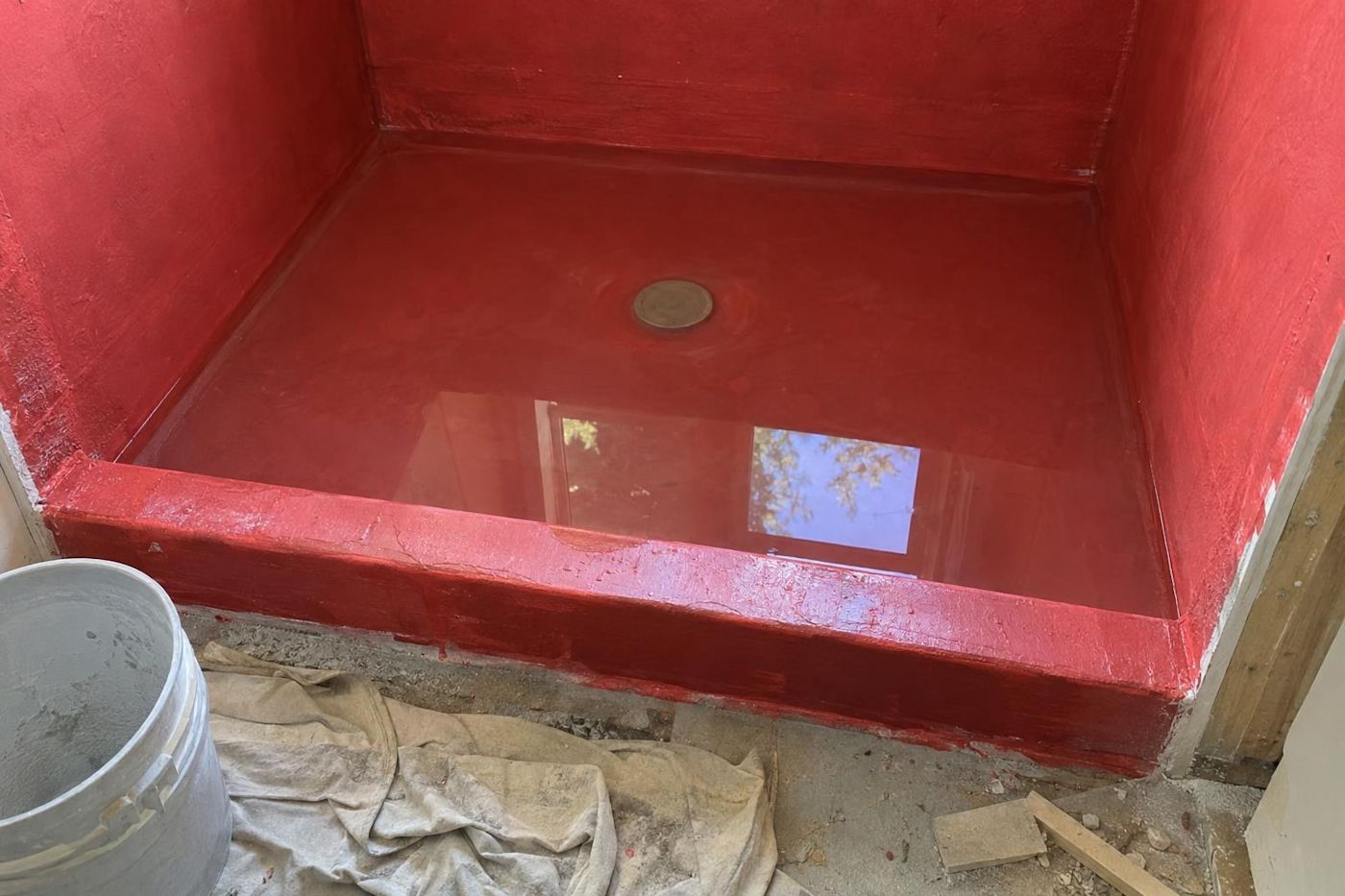
- Plug the drain with a test plug placed so the test reaches the liner or membrane where it meets the drain.
- Fill to the level of the rough threshold, at least 2 inches deep. For a curbless shower, build a temporary dam at the entry.
- Mark the water line with tape or a pencil.
- Leave it. Code sets the test depth, and many inspectors and installers let it sit for about 24 hours.
- Check the mark, the outside of the curb and any ceiling below for dampness before draining.
With a liner shower, the liner is tested before the top mortar bed is placed. With sheet and liquid membranes, the test is done on the finished membrane surface, after its cure time.
Tip: Ask your contractor for photos of the water level against the mark at the start and end of the test. Once the tile is set, there is no other way to see what's underneath.
Choosing a system and a contractor
Each method works when it's installed correctly. General guidance:
- Curbless or linear-drain showers: bonded sheet systems with foam trays make thin, even slopes easier.
- Standard curbed showers with niches or a bench: a liquid membrane over cement board handles odd shapes well when coats are applied to full thickness.
- Odd-shaped or very large custom pans: a mortar bed with a liner or hot mop is still a sound choice when the pre-slope is right and the weep holes are protected.
What matters more than the brand is how the installer handles corners, seams, drain and valve penetrations, and whether they flood test. Questions to ask:
- Which waterproofing system and backer board are in my bid, by name?
- How do you treat corners, the curb, the niche and the valve?
- Which thin-set will you use, and does the membrane maker approve it?
- When will you flood test, and will I get photos?
Material cost is a small part of the price. Preparation, the pre-slope, the drain, the details and the test are where the labor goes. For overall pricing, see our cost to retile a shower guide. If you'd rather avoid grout altogether, grout-free shower wall panels are an alternative to tile on the walls.
GVD installs tile showers with sheet and liquid waterproofing systems; we don't hold a manufacturer certification for these products, and we follow each manufacturer's published instructions.
Frequently Asked Questions
Can you waterproof a shower without removing the tile?
No. A sealer on the grout slows absorption, but it can't create a membrane behind the tile. If water is already reaching the walls or subfloor, the tile has to come off so the waterproofing can be rebuilt.
Do I need a permit to redo a tile shower in Sacramento?
Often, yes. The City of Sacramento issues a Minor Bathroom Remodel Permit for removing and replacing fixtures and finishes in kind, and replacing a shower pan or valve brings in plumbing code requirements. Sacramento County, Roseville, Elk Grove and other cities set their own rules, so confirm with your building department.
How high should shower waterproofing go?
Code requires a nonabsorbent wall surface to at least 6 feet above the floor, and the pan liner must turn up at least 3 inches above the finished threshold. Many membrane makers call for waterproofing to at least the showerhead, and in a steam shower, over the ceiling too.
How long should a flood test last?
The CPC sets the depth, at least 2 inches up to the rough threshold. Many inspectors and installers leave the water for about 24 hours. Liquid membranes have to be fully cured first, which can take longer in cold weather.
Sources
- 2025 California Plumbing Code, Section 408.8 and 408.8.1 to 408.8.5: shower receptor lining, materials and watertightness test
- 2025 California Residential Code, Section R327.2: nonabsorbent shower wall surfaces
- City of Sacramento CDD-0418 Residential Bathroom Remodel handout (revised January 2026) and City of Roseville 2025-code bathroom remodel handout
- TCNA list of ANSI A118 standards: A118.1, A118.4, A118.10, A118.15
- Schluter Shower System Installation Handbook and ICC-ES ESR-2467 (KERDI)
- Custom Building Products RedGard technical data sheet TDS-104
- LATICRETE Hydro Ban data sheet DS-663
Checked November 2026. Manufacturer instructions are updated often and local inspectors may add requirements; follow the current data sheet and your building department.
Get a Shower Built to Hold Water
GVD Renovations builds and replaces tile showers across the Sacramento region with the waterproofing system, drain details and flood test spelled out before work starts. See our shower replacement services and bathroom remodeling, or compare tile and grout-free wall options at our Rocklin showroom (6848 Five Star Blvd #6). GVD Renovations Inc. is licensed by the California Contractors State License Board (#989637) and insured.
Reviewed by our team at GVD Renovations, a licensed general contractor. While we strive for accuracy, project specifics vary. Contact us for a personalized assessment. Product details, specifications, or warranties may have changed since publication. Brand and product mentions reflect our professional opinion, not endorsements or guarantees.
Tags: shower waterproofing, shower pan liner, waterproof membrane, flood test, tile shower, sacramento,
Written by Paul Kho


