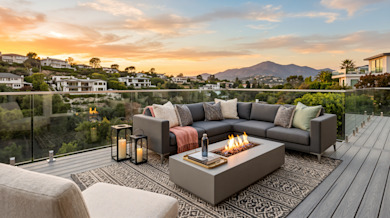
Deck Builder in Sausalito
A new Sausalito deck designed for cool, damp bayside conditions: site-measured design, permits handled when required, and a detailed firm-price proposal. Also serving Marin City and Mill Valley.
Expert Deck Builders in Sausalito
Transform your home's exterior with timeless elegance using GVD Renovations & Remodeling' top-quality decking solutions. Our expert team has assisted numerous homeowners in bringing their dream outdoor spaces to life. Allow us to guide you in selecting the perfect materials, designing an optimal layout, and scheduling a seamless installation for your decking renovation.


Tap images to enlarge
See More Recent Projects →A Sausalito deck project, at a glance
The shape of a typical Sausalito deck project with GVD, before your own site is measured.
Key Takeaways
- Dark composite and PVC boards absorb radiant heat and run warmer underfoot than light ones, so color choice is a comfort decision as well as an aesthetic one.
- One project manager coordinates scheduling and inspections for the life of the project, from the first measurement through final sign-off.
- On GVD's pricing a redwood deck costs more than a standard composite build, because the wood tier is redwood rather than pressure-treated pine.
- A deck attached to the house, or built more than 30 inches above grade, typically needs a permit and inspections.
- Elevated and second-story decks cost more because they need deeper engineered footings and additional structural support, not because of the decking surface.
What a GVD deck project covers
From low platforms off a back slider to elevated decks on steep lots, GVD Renovations handles deck design, permitting where required through the City of Sausalito or Marin County, and construction in Sausalito. We are licensed (#989637) and carry liability and workers' compensation coverage. We also build decks in nearby Marin City, Mill Valley, and Corte Madera, and every design starts with a measurement of your grade and attachment point.
Two facts decide whether your deck needs a permit: what the structure attaches to and how far the finished surface sits above grade. Neither is settled by looking at a rendering, so GVD measures height above grade and inspects the attachment point during the estimate. That establishes the permit path in Sausalito or with Marin County before any framing is priced.
A deck is a structural project wearing a finish product, and the part that decides whether it lasts is the framing and the ledger rather than the boards on top.
What a deck costs in Sausalito
The deck material you choose is a maintenance commitment as much as a purchase, since redwood asks for periodic sealing and attention over its life while composite trades that upkeep for a higher position on the material scale. Knowing which upkeep pattern you are signing up for before you call keeps the tier conversation honest rather than a surprise years later.
A deck budget is really two budgets: the structure underneath, which is set by the site, and the surface on top, which is set by taste.
A $5,000 budget buys a small ground-level pressure-treated deck under 100 square feet, which is worth stating so the tiers above have a lower bound to read against.
The complete cost breakdown is on our main decking page.
Two quotes for the same footprint usually differ mainly on the surface material, since the framing, footings, and railing underneath carry a similar base cost. What pushes an elevated or second-story deck higher is the deeper footing work and added structure.
Wood, composite, and PVC compared
The comparison below is about how each material behaves over a decade of ownership rather than what it costs on invoice day.
| Attribute | Redwood | Composite | Full PVC |
|---|---|---|---|
| Installed cost | Above standard composite | The most common build | Above both |
| Maintenance | Refinishing on a regular cycle | Rinse and mild soap, no sealing | Rinse and mild soap, no sealing |
| Surface in direct sun | Stays closer to air temperature | Darker colors absorb more heat | Darker colors absorb more heat |
| Moisture and stain resistance | Good for a natural material, but it is still wood | Strong; capped boards resist staining | Strongest of the three |
| Look | Natural grain that weathers | Consistent, wood-look texture | Consistent, the least wood-like |
Note the cost order, because it is the reverse of the usual assumption: redwood sits above standard composite here. The wood option is a premium material rather than a budget one, so the composite decision is not about paying more now to save later.
In Sausalito's marine air, moisture is the bigger concern than heat. Shaded corners and the north side of a deck can stay damp long enough to grow mildew on any surface, so board spacing, airflow under the frame, and a cleaning routine matter more here than board color. Capped composite and full PVC handle the damp better than wood.
Trex, TimberTech, and DuraLife
Every line here has a track record long enough to judge. The question is which color and texture you want to look at for twenty-five years.
We install Trex's Transcend and Enhance lines, TimberTech and its AZEK full-PVC line, and DuraLife. There is no clear quality gap between the brands; they differ on color range, texture, railing and fastener systems, and price point. What does matter is capped composite (a wood-fiber core with a protective shell) versus full PVC (no wood at all, better moisture and stain resistance, higher price).
Do you need a permit to build a deck in Sausalito?
Guardrail height, stair geometry, and ledger attachment are all inspected where a permit applies, and the City of Sausalito or Marin County determines whether your project reaches that threshold.
A deck typically skips permitting only if it is freestanding, 200 square feet or smaller, no more than 30 inches above grade, and not the required exit from a door. Attach it to the house, build it larger, or build it higher, and it generally needs a permit and inspections.
If your deck needs a permit, GVD handles the plan check submission and inspection scheduling with the City of Sausalito or Marin County as part of the job.
Deck code requirements and inspections
The code requirements below are worth understanding because they explain most of the framing cost and all of the inspection schedule.
The framing rules cover the parts you will not see: footing depth and bearing, how the ledger attaches to the house rim joist, and joist spacing matched to the decking's rated span. Guardrails are required at 30 inches or more above grade, and stair geometry and baluster spacing are checked at final.
A deck is typically inspected at two or three points: footings before they are covered, framing and ledger attachment, and a final once decking, railing, and stairs are complete. Ledger flashing is a common reason for a return trip, because the house's weather-resistive barrier has to lap correctly over the ledger, so GVD flashes it to manufacturer specification on the first pass.
Elevated and second-story decks
A deck on a slope has to be designed against the actual grade rather than a standard spacing pattern, and that is a survey question before it is a carpentry one.
The structural half of a deck quote is the half that varies most between properties, because it follows the site rather than the plan.
A lot where the grade drops away from the house faster than a ground-level deck can follow needs an elevated or second-story structure: engineered footings poured to depth, a ledger connection rated for the added load, and guardrails at full code height. GVD lays out footings against the actual slope rather than a standard flat-lot pattern, which is often what separates a deck that passes framing inspection from one that does not.
How we build your deck
This is the standard sequence across the trade. A contractor proposing to reorder it should be able to say exactly why.
Each stage has to close out before the next begins, which is why a deck cannot be compressed the way some projects can. Footings and framing in particular gate everything after them.
How long a deck takes to build
The on-site portion runs one to three weeks for most projects, with footing curing and the inspection schedule setting the pace rather than the crew size.
Plan check timing is the biggest unknown before construction starts. Once building begins, elevated and second-story decks take longer than ground-level ones because of deeper footings and more inspections.
Maintaining your deck
Upkeep on a modern deck is closer to cleaning a patio than to maintaining a wood structure, which is the point of the material.
Why Sausalito homeowners hire GVD Renovations
The question that matters most comes three years after the build: if a board cups or a railing connection loosens, who answers the phone? A local licensed contractor is a fixed address you can reach, and GVD's license stays on record against the work we performed here. A national franchise routes that call through rotating out-of-area crews who may no longer be in the region. When a permit is required in Sausalito or unincorporated Marin County, GVD handles the permitting process and takes the framing through the inspections the county expects. One accountable team from quote to walkthrough builds your deck, so the people who set your footings are the people you reach later, not a handoff you never met.
We have worked through plan review with the City of Sausalito or Marin County and neighboring jurisdictions, so when a permit is required our submittals match what inspectors expect.
Recent deck projects near Sausalito
Recent deck building projects we have completed in nearby communities:
- James Hardie Siding Shed Deck And Railings in Mill Valley (94941)
Serviced ZIP Codes: 94965, 94966
Try Our 3D Home Design Visualizer!
Ready to explore the possibilities for your home? Snap a photo to get started or spark your imagination with our sample homes.
Start Designing


Elite Certifications: James Hardie & LP® SmartSide
As a James Hardie Elite Contractor and LP® Certified Installer & LP® Master Level Preferred Contractor, we meet the highest standards for installation, service, and customer satisfaction in the industry.
We are fully insured with worker's compensation and general liability insurance to safeguard you and your home during our work.


GAF Certified Roofing Contractor


2025 James Hardie Service Excellence Award


LP Certified Installer Certificate


Angie's List Super Service Award

VSI Certified Installer

Best of Houzz 2020 Service Award


Financing made simple
- Fast application process
- Flexible payment options
- Check eligibility in minutes
Financing is offered through third-party lenders. Approval, rates, and terms depend on credit profile. Not all applicants qualify.

Checking eligibility will not impact your credit score






4.6/5

4.9/5

A+

5/5

5/5

5/5

5/5

4.8/5

5/5
Deck Builder Near Sausalito
We bring the same crews, materials, and workmanship to every community around Sausalito.
Frequently Asked Questions
about Deck Installation & Replacement in Sausalito
What does deck building cost in Sausalito?
A standard composite deck typically costs $17,000 to $30,000 with GVD. Redwood runs $25,000 to $35,000, premium PVC or stone surfaces $30,000 to $45,000, and large custom or covered decks $45,000 and up. Sloped lots and elevated decks cost more because of deeper footings and extra framing.
Does a deck in Sausalito require a permit?
It depends on attachment, height, and size. Under the California Residential Code, a deck is generally exempt only if it is 200 square feet or smaller, no more than 30 inches above grade, freestanding, and not serving a required exit door. GVD handles any required permits through the City of Sausalito or Marin County.
How long will my deck project take?
Construction usually takes one to three weeks once permits clear. Plan check timing and elevated framing are the main variables.
Is composite or redwood better for a deck?
Composite usually wins on both price and upkeep, since GVD's wood option is redwood rather than pressure-treated pine. Choose redwood if you want real wood grain and are willing to refinish it periodically.
What decking brands do you offer?
GVD installs Trex (including Transcend and Enhance), TimberTech (including AZEK full PVC), and DuraLife. The bigger choice is capped composite versus full PVC, which affects moisture resistance and price.
Where can I compare decking and railing options?
At our Rocklin showroom on Five Star Blvd, where you can compare boards, railing, and colors in person. Samples can also come to your house during the consultation.